
Paradigm
Paradigm’s Culture for Everyone Platform seamlessly integrates AI-enabled software with a team of experts to help companies build high-performance cultures where everyone can do their best work.
Culture Isn’t a Soft Metric
The CHRO’s Guide to Proving the Hard ROI of Talent Intelligence
Culture determines how well an organization performs. Most CHROs already know this. But knowing it and proving it are two different problems, and the gap between them is growing.
In 2026, HR leaders are working under a paradox: culture has never been more strategically important, but budgets remain stubbornly flat. According to Gartner, most CHROs are being asked to reassess budgets to focus on the highest-value priorities. Simultaneously, they’re also being asked to lead AI transformation, build the conditions for organizational adaptability, and demonstrate measurable returns on every talent dollar spent.
The challenge isn’t a lack of data. Most organizations have more people data than ever: HRIS records, engagement surveys, performance reviews, attrition patterns, workforce planning documents. The problem is that the data lives in disconnected systems and stops short of explaining what it means or what to do about it.
HR leaders who want to make the case for culture investment need more than a better argument. They need an AI-native intelligence layer that connects talent data directly to business performance and produces the evidence that boards and CFOs will act on.
This playbook shows you how.
CHAPTER 1
The Hard ROI of High-Performance Cultures
The business case for culture investment isn’t soft. The data is clear.
According to Harvard Business Review, when employees feel a genuine sense of belonging, job performance rises by 56% and turnover risk drops by 50%. Our Benefits of Belonging report also found that when organizations close belonging gaps for lagging groups, overall engagement climbs by seven points across the entire workforce, not just for the groups targeted.
The inverse is equally clear. Gallup found employee wellbeing costs organizations $20 million in lost opportunities for every 10,000 employees, and $322 billion in turnover and lost productivity costs. And only one in four US employees strongly believe their organization cares about their wellbeing.
High turnover costs organizations an average of 33% of a departing employee’s annual salary in replacement expenses, according to the Work Institute’s 2026 Employee Retention Report. And voluntary departures, the most expensive kind because they’re concentrated in high performers, are 75% preventable when the right people systems are in place.
These aren’t culture metrics. They’re financial performance metrics. The organizations that recognize this distinction treat culture investment the way they treat product investment: something to measure, optimize, and connect to business outcomes, not a program to defend at annual planning cycles.
For HR leaders, this reframing is the first and most important move. The board conversation changes when the metrics change. Not “our engagement scores improved” but “our belonging investment reduced turnover in engineering by 20%, which at our replacement cost represents $4.2M in retained value this year.”
That’s a different conversation, and it requires different infrastructure to support it.
CHAPTER 2
How Surface and Reach Drive Immediate Financial Value
Understanding the ROI of culture investment is the first move. Generating it and demonstrating it requires the right infrastructure.
Most HR leaders are still operating with a technology stack built for a different era: HRIS systems that track the workforce, engagement platforms that survey it, performance tools that score it. What they rarely have is a layer that connects those signals together, interprets what they mean in context, and produces the finished work to act on them.
That’s the gap Surface closes.
Software Consolidation
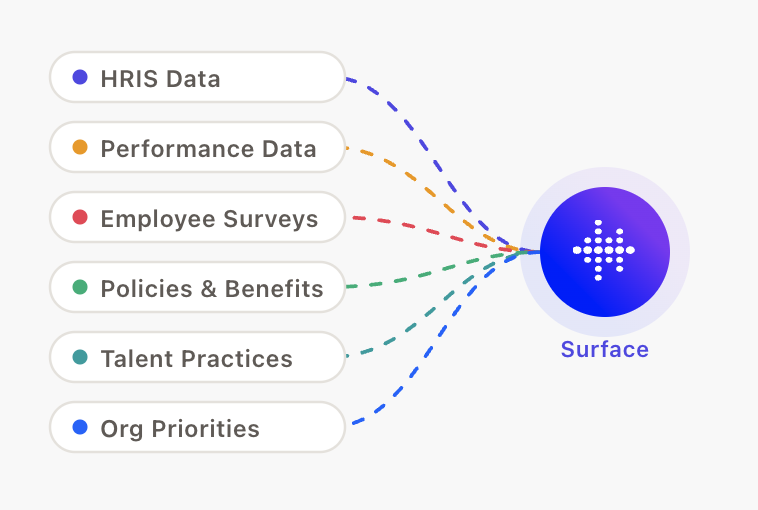
Surface functions as a unified intelligence layer that integrates data from across an organization’s HR stack: HRIS, performance tools, engagement surveys, recruiting platforms, policy documents, and more. For organizations currently paying for multiple point solutions to patch together workforce visibility, Surface replaces that fragmentation with a single, connected view.
Paradigm’s analysis found that the average organization displaces approximately $275,000 in annual external spend by consolidating with Surface, replacing separate analytics tools, data visualization licenses, and ad-hoc consulting engagements with a single platform.
Overhead and Consulting Reduction
Before AI-native intelligence platforms, translating workforce data into a board-ready strategy typically required a six-figure consulting engagement and months of diagnostic work. Surface runs that analysis and creates the board deck in minutes. It identifies organizational hotspots, generates prioritized recommendations, and drafts executive briefs that are ready to present, not ready to revise.
According to our research, Surface compresses the diagnostic-to-deliverable cycle from six months to days. HR teams reclaim capacity that was previously absorbed by manual data cleaning, static dashboard maintenance, and report generation, and redirect it toward higher-leverage strategic work.
Executive Board Reporting
The board presentation is one of the highest-stakes moments for any CHRO. It’s where culture investment is either defended with evidence or explained away with anecdote.
Surface produces data-rich Executive Board Briefs and quarterly reports that CHROs can bring to that meeting with confidence. These aren’t summaries of survey results. They’re structured analyses connecting workforce signals to business outcomes: attrition risk by manager cohort, capability gaps mapped to performance risk, belonging scores benchmarked against industry peers, in a format that’s ready to share the moment it’s generated.
Scalable Behavior Change
The financial case for culture investment only holds when it compounds over time. That requires behavior change at scale, the kind Reach, Paradigm’s eLearning platform, is designed to deliver.
Reach provides continuous microlearning journeys tailored to specific audiences: managers, individual contributors, ERG leaders, and executives. Unlike one-off training programs that measure participation rather than capability development, Reach tracks behavior change over time and integrates with live facilitation for blended learning programs.
87% of Reach learners would recommend Paradigm courses to colleagues. Organizations using Reach have seen a 43-point increase in employees’ understanding of inclusion strategies. And Reach connects directly with Surface, creating a closed loop: Surface identifies where belonging gaps and capability deficits are affecting performance; Reach delivers targeted learning to close them; Surface tracks whether the investment is working.
CHAPTER 3
Overcoming Executive and Board Objections
Even the clearest ROI case for culture investment will encounter resistance. Here’s how to address the most common objections with precision.
Objection: “We can build this ourselves using ChatGPT or Copilot.”
The appeal of general-purpose AI is understandable: it’s fast, widely available, and less expensive than purpose-built software. But the DIY approach carries real hidden costs.
General-purpose models reason from publicly available data. They don’t know your organization’s specific workforce signals, your internal policies, or how your talent practices compare to peer companies at your stage and size. They produce plausible-sounding outputs, not grounded ones.
Surface is purpose-built for HR. Every recommendation it produces is grounded in your organization’s actual data: HRIS records, survey responses, performance patterns, cross-referenced against Paradigm’s Talent Practices Inventory, built from 12+ years of data across 200+ organizations. The difference between a generic recommendation and a context-specific one is the difference between a direction and a decision.
DIY AI also creates governance risk. When general-purpose AI is applied to sensitive HR data without proper controls, the organization is exposed to privacy liability, compliance failures, and bias amplification that purpose-built, enterprise-grade platforms are designed to prevent.
| DIY AI (ChatGPT, etc.) | Surface | |
| Data Grounding | Public data only | Your org data + Paradigm benchmarks |
| HR Domain Expertise | Generic | 12+ years embedded expertise |
| Benchmark Context | None | 200+ peer organizations |
| Compliance | Requires custom governance | SOC 2 Type II, GDPR, CCPA |
| Output Type | Text responses | Finished, stakeholder-ready deliverables |
Objection: “Can’t we do this with a people analytics platform?”
This objection often comes from teams already evaluating or running a people analytics platform, where leaders assume more data and better dashboards close the gap.
People analytics platforms are good at what they do. They pull together multi-source data and surface real patterns. But they stop at insight. What you do next, the policy draft, the board deck, the action plan, the manager communications, still falls on your team to build from scratch.
That’s where Surface helps People teams take action. It doesn’t just analyze data across your HRIS, engagement, performance, and exit signals. It produces the work your team would otherwise spend weeks building: a prioritized analysis, a 30/60/90 plan, a training curriculum, a board-ready deck with the narrative already written. The output is a finished draft, ready for review.
If your team already runs a people analytics platform, Surface turns what that platform finds into something you can actually ship.
Objection: “Is it safe to put our HR data into an AI platform?”
This is the right question to ask, and CHROs should have a clear answer ready for InfoSec and legal teams.
Surface was built with enterprise-grade security from day one: GDPR and CCPA compliance, end-to-end encryption, and single sign-on (SSO).
Paradigm’s commitment to your data privacy is explicit: Surface does not train 3rd party models, which is typically the biggest concern. Paradigm’s benchmarks are also aggregate, anonymized files so that your employee data is never shared across customers.
[Visual notes: Security and compliance badge strip — SOC 2 Type II, GDPR, CCPA]
The Paradigm Trust Center documents every security and compliance commitment for internal review and vendor evaluation processes.
How to Drive Immediate Impact
Proving the ROI of culture investment doesn’t begin with the board presentation. It begins with the intelligence infrastructure to generate evidence that stands up to scrutiny.
CHROs who succeed in securing sustained culture investment aren’t making better arguments. They’re making different ones, grounded in workforce data connected to business outcomes rather than surveys connected to sentiment scores.
Surface gives you the infrastructure to make that shift. Here’s where to start:
- Identify the highest-leverage hotspots. Surface identifies where culture and capability gaps are most directly connected to financial performance risk, in prioritized order, weighted by impact, not by what’s easiest to change.
- Use the Surface Agent to generate action plans and board briefs. Surface Agent drafts the analysis, the recommendations, and the stakeholder-ready narrative. What previously required months of diagnostic work ships in days.
- Establish clear ownership alongside Surface-generated plans. The plans are finished. They still require human judgment to execute. Surface handles the synthesis; your leaders handle the accountability.
Ready to stop defending the culture budget and start building the business case for it?
Connect with your Paradigm representative to map how Surface can tie your culture investments directly to business outcomes.