Paradigm
Paradigm’s Culture for Everyone Platform seamlessly integrates AI-enabled software with a team of experts to help companies build high-performance cultures where everyone can do their best work.
A framework for HR leaders who are getting good data from their HRIS but still can’t answer their most important questions.
A CPO at a fast-growing technology company asked their people team a deceptively simple question: “Are my engineers quietly checked out?”
Engineering attrition had ticked up. Engagement scores were flat. Their HRIS had faithfully tracked every headcount change, performance rating, and compensation adjustment for years, and it still couldn’t answer the question.
Not because the platform failed. Because quiet disengagement often doesn’t leave a clear trail in HRIS data until someone puts in their notice. The signals that would have surfaced the answer lived somewhere else entirely: in engagement survey comments, performance review patterns, and cross-source signals the HRIS was never designed to see.
That gap between what your HRIS knows and what’s actually true in your organization is what this playbook is about.
Let’s take a closer look at where HRIS analytics excel, where their visibility naturally ends, and what becomes possible when those signals are connected across your broader HR stack.
Every HRIS Vendor Says “We Have AI.” Here’s What That Actually Means
The HRIS analytics market has moved fast. Every major platform, including Rippling, Workday, BambooHR, and the rest, has launched AI-powered analytics capabilities in the last two years, and most are genuinely useful.
- Attrition prediction models that flag flight risk before someone starts interviewing
- Headcount trend analysis surfaced automatically
- Comp-ratio alerts that catch compensation compression before it becomes a retention issue
These are real capabilities that can save HR teams time and help pinpoint workforce trends earlier.
But it’s worth separating what these platforms actually are: HRIS systems with AI features bolted on, not people analytics tools built for the job. The AI in your HRIS platform is designed to analyze the data that already lives in that system. A dedicated people analytics tool exists specifically to pull signals across multiple systems and answer questions no single source can.
Let’s return to the CPO question: “Are my engineers quietly checked out?” When a question requires that broader view, an HRIS’s built-in analytics can only provide part of the answer.
Quiet disengagement doesn’t register in HRIS data until someone has already decided to leave. The signals that would surface it earlier, such as survey responses trending negative, performance review comments pointing toward unclear priorities, and patterns in skip-level feedback, often live across multiple systems.
This isn’t a single organization’s problem. In recent conversations with Paradigm customers in B2B, food and beverage, utilities, and other industries, we saw the same pattern emerge independently. Each company was using Rippling and getting value from its analytics capabilities. Yet all three eventually ran into questions that required context from outside the HRIS to answer confidently.
Three organizations, same platform, same conclusion: the ceiling is structural, not a product failure.
The HRIS Ceiling Is a Design Constraint
HRIS platforms are built to do one thing exceptionally well: be the authoritative system of record for the workforce. Headcount, compensation history, tenure, job codes, performance ratings, reporting relationships, all organized, retrievable, and increasingly analyzable. When the question lives in those records, HRIS analytics gives you a real answer.
The constraint is specific: AI is only as smart as the data it can see. Depending on the performance, analytics, and job history data it has access to, HRIS analytics can show you:
- Higher-than-average turnover in Engineering over the last two quarters
- Senior engineers overdue for promotion relative to their tenure band
- Manager effectiveness scores below your organization’s median
What it can’t show you is whether Engineering attrition is driven by manager behavior, comp compression, or a pattern in performance reviews about unclear direction. Those answers often require additional context from engagement surveys, exit interview themes, performance feedback, and other workforce signals that sit outside the HRIS.
Single-source analytics give you a partial picture and call it a diagnosis. That’s not a criticism. The ceiling is structural and by design. HRIS platforms were built to be systems of record, not repositories for every source of workforce insight. The challenge emerges when the question spans multiple sources, and many of the most important workforce questions do.
Where HRIS Analytics Stop, and Where the Answers Live
The following table is a self-diagnostic. Find a question you’ve actually tried to answer in the left column, and note where you ended up.
| The question | What your HRIS might show | Where the answer actually lives |
| Are my engineers quietly checked out? | Tenure, attrition history, headcount | Engagement survey comments, team feedback themes, performance review patterns |
| Is my manager development program working? | Completion rates, training logs | 360 feedback, skip-level survey results, employee comments |
| Why are sales leaders leaving at higher rates at the Director level? | Promotion rates, attrition by level | Exit interview themes, survey data on belonging and sponsorship, comp benchmarks |
| Is my onboarding working for new hires? | 90-day retention, time-to-productivity | Survey responses (day 30, day 60, day 90), manager ratings of new hire readiness |
| How does our culture compare to peers? | Internal metrics only | External benchmarks across 200+ peer organizations |
If you’ve tried to answer any of these questions and found yourself pulling from multiple systems, triangulating by hand, or ultimately landing on “we think it’s X but we’re not sure,” you’ve probably encountered the limits of a single-source view. The question is how much that’s costing you.
What Becomes Possible When Data Sources Connect
Surface isn’t a replacement for your HRIS. It’s built to integrate with it, and that distinction matters. Surface needs your HRIS data to function. The integration is the starting point, not the competition.
What Surface adds is the cross-source layer: HRIS data connected to survey responses, performance review data, exit interview themes, and the institutional knowledge that shapes how culture actually operates and typically lives outside formal systems.
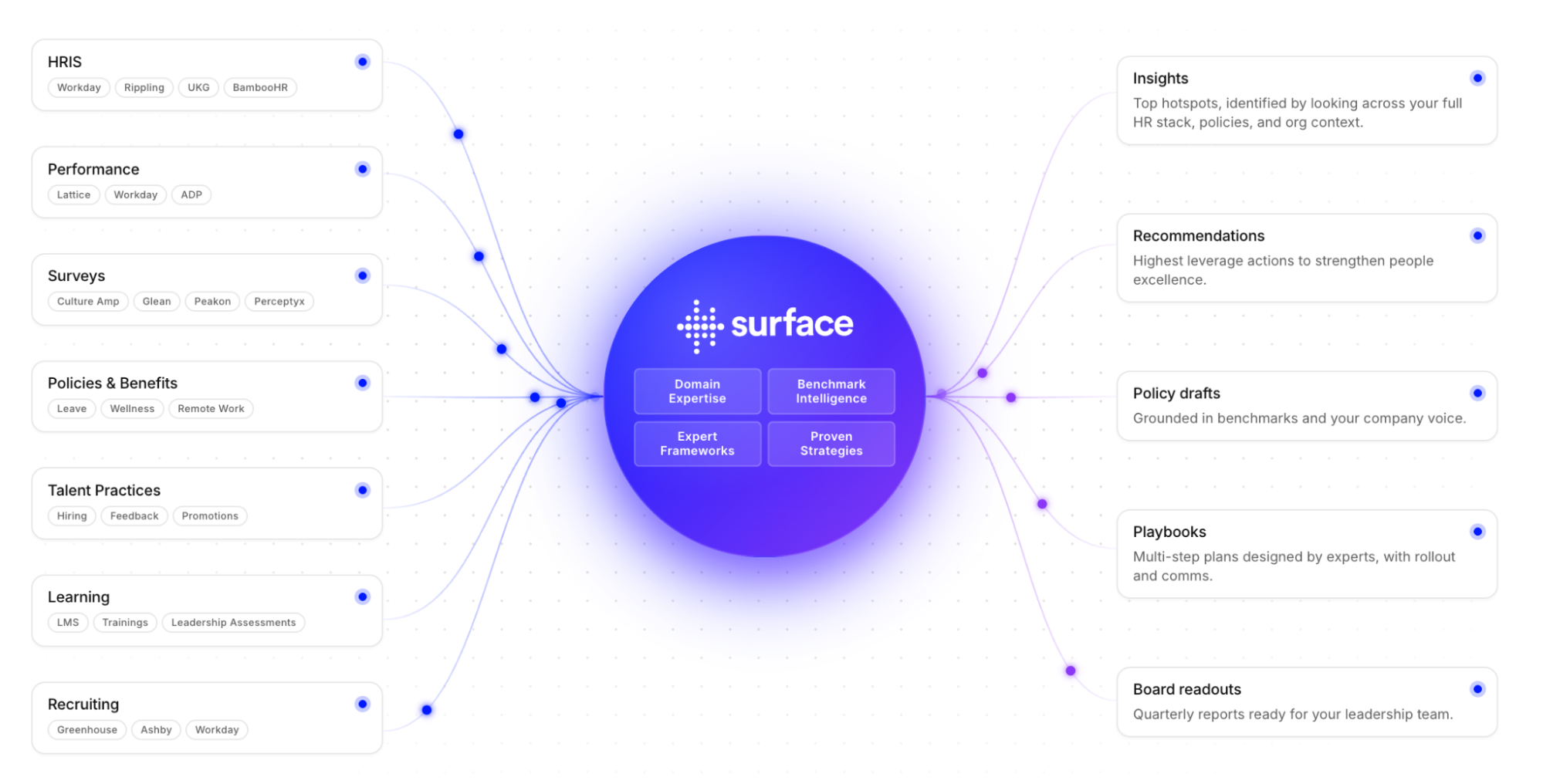
Here’s what that looks like in practice. An Engineering team is showing declining performance and elevated attrition in HRIS data. Tenure is declining, performance ratings are trending down, and two senior ICs gave notice last quarter. With only HRIS data, the next move is manual: pull survey results, review exit interview notes, speak with managers, and try to connect the dots across multiple sources.
With a cross-source view, Surface connects the attrition signal to below-average manager effectiveness scores from the engagement survey, a pattern of 360 feedback comments about unclear priorities and inconsistent recognition, and below-peer compensation benchmarks for senior ICs in the same function.
Rather than reviewing each signal separately, leaders can see how those factors relate to one another and which appear to be contributing most to the outcome. The HRIS surfaced an important part of the picture. Surface connects that signal with related workforce data and produces a recommended response: a prioritized root-cause summary, a 30/60/90 action plan, and the materials needed to move on it.
The distinction isn’t just a better answer. It’s finished work from that answer. Not another dashboard pointing toward more digging, but a deliverable to act on.
Connection Is Only the Starting Point: Intelligence Turns Signals Into Decisions
Connecting workforce data is valuable. Most organizations already have access to the underlying information. But as HR.com’s 2025–26 State of People Analytics report shows, collecting workforce data and acting on it are not the same thing. The report found that only 45% of HR professionals believe their analytics systems improve talent and business decisions.
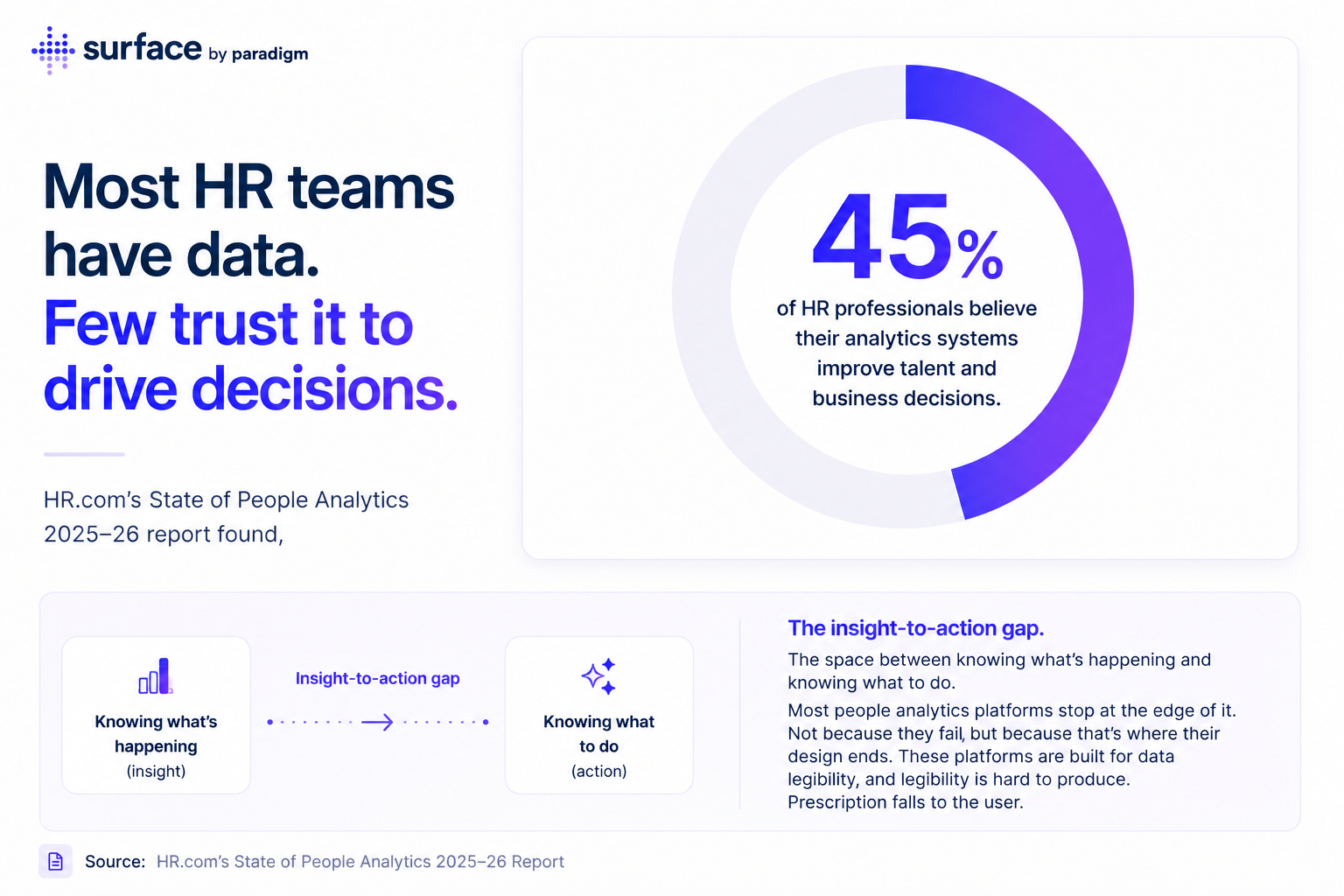
An intelligence layer helps close that gap. It helps you understand what’s driving a workforce outcome, how it compares to peer organizations, and where to focus first. Instead of reviewing multiple datasets, weighing competing explanations, and building recommendations from scratch, you get a prioritized view of the issue and a path forward.
Workforce challenges rarely have a single cause. Attrition might be linked to manager effectiveness, career progression, compensation, workload, or a combination of factors. Surface brings those signals together, helps identify likely drivers, and highlights the actions with the greatest potential impact.
Context shapes how those signals should be interpreted. A decline in engagement scores might be concerning in one organization and expected in another. A compensation gap might explain turnover in one function while having little influence elsewhere. Surface combines organizational data, benchmark data, and workforce signals to help you understand how your organization compares to peers and where attention is most needed.
Surface also helps move work forward. It can generate prioritized recommendations, policy drafts, communications materials, board-ready deliverables, and action plans grounded in your data and benchmark context.
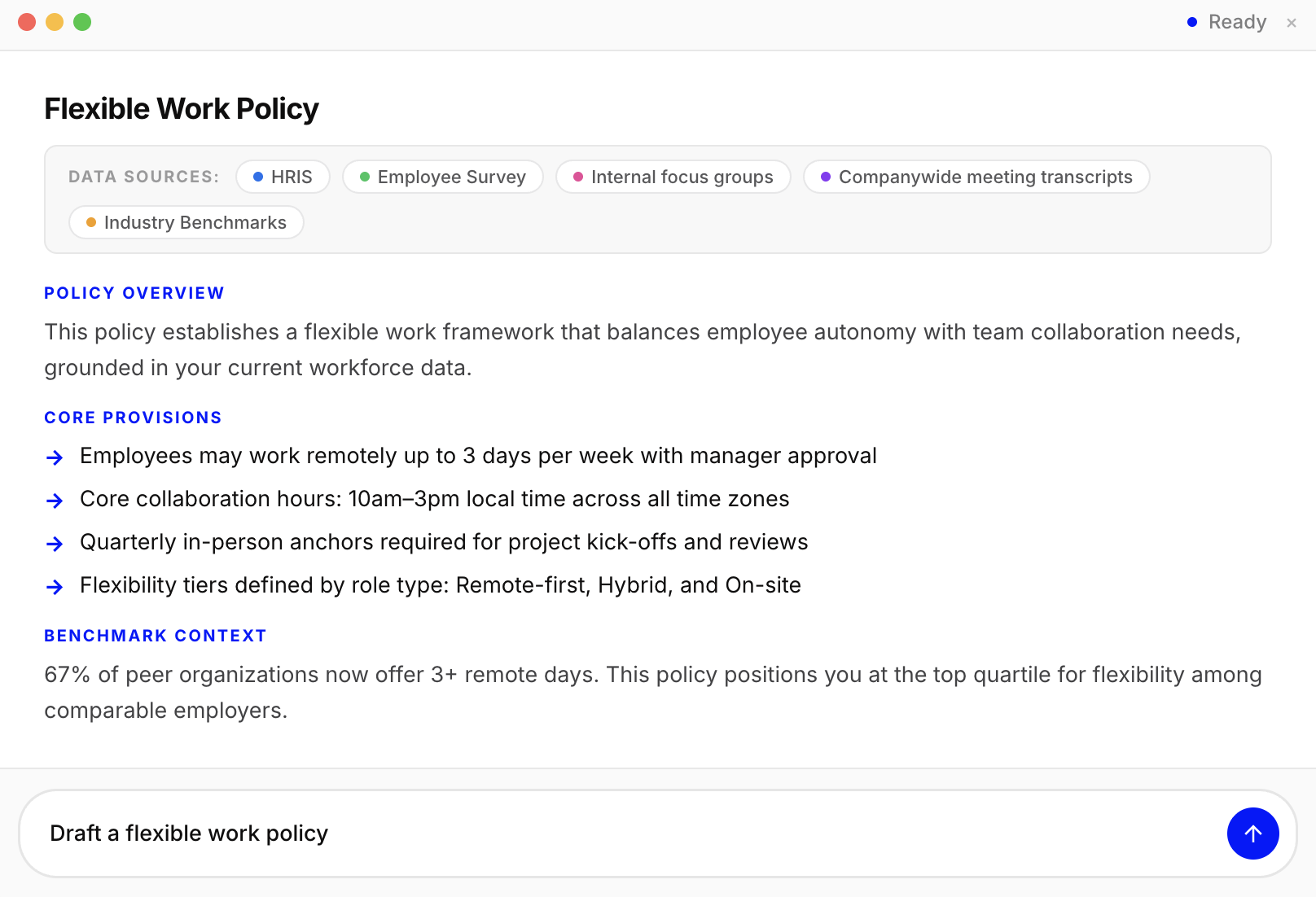
Rather than spending weeks aligning stakeholders around what the data means, you can focus on deciding what to do next and how quickly you can act.
After all, the purpose of workforce intelligence is to improve business outcomes.
Josh Bersin Company describes mature people analytics organizations as those that move beyond reactive reporting and into proactive problem-solving. Research conducted with Visier found that organizations with more mature people analytics capabilities are:
- 3x more likely to outperform their financial targets
- 8x more likely to achieve high workforce productivity
- 9x more likely to adapt successfully to change
- 7x more likely to drive effective innovation
Those outcomes are why organizations invest in workforce intelligence. While better visibility helps, workforce data becomes the most valuable when it helps leaders make better decisions, take action faster, and improve business performance.
Surface Works With Your Tech Stack, Not Instead of It
When organizations consider adding a new layer to their HR stack, the first question is usually the same: does this mean replacing something, or creating more integration debt?
The answer is no. Surface integrates with existing HRIS platforms, working with data already in your environment. Its goal isn’t to become a new system of record. It’s to sit above the existing stack, pull data across sources, and return finished analysis those systems couldn’t produce individually.
In practice, your HRIS continues serving as the system of record for workforce data. Your performance management platform continues managing reviews and feedback. Your ATS continues managing the hiring process. Surface connects those sources, bringing the signals together in a way that makes cross-source analysis possible.
Rather than creating another destination for HR teams to manage, Surface works with the systems already in place and helps connect insights that would otherwise remain separate.
Surface doesn’t need you to change your existing HR tools. It needs to connect to them.
Checklist: Is Your Organization Hitting the HRIS Ceiling?
Use this as a five-minute self-assessment.
- You’ve asked a question about your people that required pulling information from multiple systems to answer confidently
- Survey data, performance data, and HRIS data live in separate systems and rarely get analyzed together
- Your most important people insights require an analyst to pull, combine, and interpret data across tools
- You don’t have consistent benchmarks to compare your practices to peer companies
- You know something is wrong with a team or function, but identifying the root cause requires information from multiple sources
- Exit interview themes, engagement survey comments, or 360 feedback rarely get connected to quantitative HRIS trends
Three or more checks means the full picture is missing. It may be worth looking at how long it takes your team to answer workforce questions that span multiple data sources.
Surface Is Your Cross-Source Intelligence Layer
Surface was built specifically for this constraint — not as a general-purpose HR tool, but as an intelligence layer that connects workforce signals across systems.
Surface connects HRIS data with engagement surveys, performance reviews, policies, benefits data, and the institutional knowledge that shapes how culture actually operates. It combines those signals with more than 12 years of Paradigm’s proprietary benchmark data across thousands of organizations. The platform analyzes relationships between signals, identifies likely drivers, and generates recommendations informed by benchmark data and organizational context. That’s what makes questions like “are my engineers checked out compared to peer companies?” answerable rather than speculative.
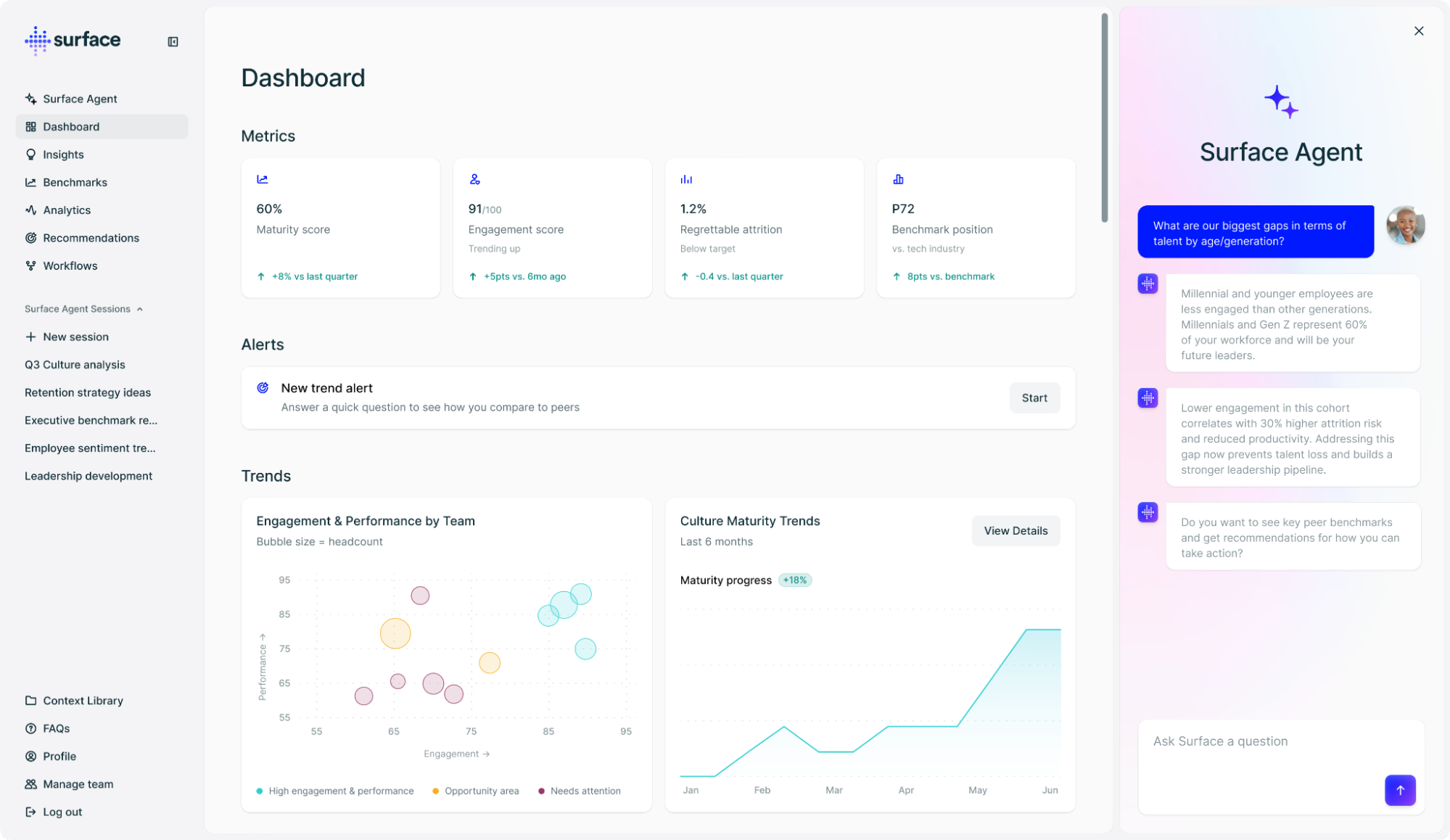
And Surface needs your HRIS to work. That’s not a limitation, it’s by design. The HRIS is the foundation. Surface is the intelligence layer on top of it.
The CPO’s question, “Are my engineers quietly checked out?,” is the perfect illustration of the challenge. The HRIS can show attrition trends, performance patterns, compensation data, and organizational changes. Answering the question fully requires signals from across the broader HR ecosystem, including engagement feedback, performance reviews, exit interview themes, and benchmark context.
In conversations with many of our current customers, we saw that same question emerge independently. Each company was getting value from their HR analytics platform. Yet all three eventually reached a point where answering their workforce questions required a broader set of signals than any single system could provide.
This isn’t a criticism of the HRIS. It’s a structural limit of single-source analytics. Surface closes that gap without requiring organizations to replace the systems they’ve already invested in.
Ready to see what Surface can do? Request a free demo today.