Paradigm
Paradigm’s Culture for Everyone Platform seamlessly integrates AI-enabled software with a team of experts to help companies build high-performance cultures where everyone can do their best work.
CHROs build strategies for their people, yet many don’t have a clear picture of what those people actually experience.
That’s the contradiction at the center of every HR planning cycle. While engagement surveys, HRIS exports, exit interview data, and performance reviews provide the necessary inputs, they live in different systems, get pulled at different times, and tell different stories. When they finally get stitched together into a roadmap, the signal is months old, and the strategy is relying on incomplete information.
Building an effective HR strategy requires a recurring commitment to understanding what’s actually happening in your organization and prioritizing the changes most likely to make a difference. The CHROs whose roadmaps drive outcomes aren’t necessarily the ones with the most sophisticated models. They’re the ones with a complete, connected view of their workforce.
This playbook provides a practical framework for HR strategy development grounded in real data, benchmarked against peers, and built to survive the CEO conversation. It also demonstrates how Surface, Paradigm’s talent intelligence layer, makes this framework something you can act on.
What Is HR Strategy Development?
HR strategy development is the process of aligning an organization’s people practices with its business objectives, typically through an annual or biennial planning cycle that assesses current talent capabilities, identifies gaps, and prioritizes the investments most likely to drive performance.
This is distinct from HR operations, which focuses on day-to-day execution:
- Strategy is about direction and prioritization over 12 to 24 months.
- Operations is about making strategy happen.
The distinction matters because these functions require different inputs, conversations, and success metrics. Rather than treating strategy as something they do once a year, great talent leaders treat it as a continuous discipline.
Why Most HR Strategies Don’t Survive Contact With Reality
Most HR strategies underperform for two structural reasons that compound each other.
Built on Incomplete Data
The average strategy relies on the last engagement survey, a handful of leadership opinions, and whatever industry benchmarks were available during its development.
The result is a roadmap built on signal that’s six to 12 months stale and siloed across multiple systems. This means CHROs make high-stakes prioritization decisions without a connected view of what’s actually happening.
Disconnected from Ongoing Measurement
Once the roadmap is built, most teams review it annually at best, breaking the feedback loop between strategy and execution outcomes. When a program fails to deliver, leaders find out at the next planning cycle, when it’s too late to course-correct.
Here’s how this might look in practice:
A CHRO builds a retention-focused strategy based on engagement scores. Since the scores are low, the strategy prioritizes programs aimed at improving morale. But because the scores were never connected to actual attrition patterns, promotion trends, or compensation benchmarks, the programs address only the symptom. Attrition continues, and when the strategy is revised a year later, the cycle repeats.
Closing these gaps requires a tool that both connects your data and maintains a feedback loop.
See how AI can help you uncover insights and boost employee performance.
The Annual Talent Roadmap: Five Pillars of Effective HR Strategy
Every annual talent roadmap should address five interconnected areas:
1. Talent Acquisition and Workforce Planning
This pillar covers supply and demand forecasting, pipeline health, time-to-fill, and offer acceptance rates.
When headcount plans don’t connect to internal mobility data and skills gaps, CHROs end up pursuing external hires for roles that could be filled internally or investing in capacity that won’t be needed in 18 months.
This disconnect also leads to higher turnover. Gallup found that in the last quarter of 2025, over half (51%) of US employees were actively seeking a new job. The biggest driver pushing them to look for other opportunities is pay or benefits, with growth or advancement ranking a close second.
What good looks like: A workforce plan that starts with the business’s 12-month growth map and works backward to identify where current capability is sufficient and where it isn’t..
2. Performance Management
Goal-setting cadence, manager effectiveness, review calibration, and high-performer retention live here.
Although most CHROs know that standard performance systems measure past behavior rather than future potential, few have redesigned these structures to bridge this gap.
What good looks like: A performance framework that informs development decisions, not just compensation ones.
3. Learning and Development (L&D)
The learning and development pillar covers skill gap identification, learning program investment, and manager capability building.
L&D strategies often fail by focusing on programs rather than outcomes. Completion rates go up, but behavior doesn’t change.
What good looks like: Learning investments tied directly to the capability gaps identified in workforce planning, ensuring L&D operates as the delivery mechanism for strategy rather than a separate function.
4. Compensation and Benefits
Here you’ll find pay equity, market positioning, total rewards philosophy, and benefits benchmarking.
A compensation strategy that’s behind market standards doesn’t just affect recruiting. It shapes sentiment scores, attrition risk, and internal mobility.
What good looks like: A comp strategy informed by both external benchmarks and internal equity analysis, not one or the other.
5. Organizational Culture and Employee Experience
Most often treated as soft, the organizational culture and employee experience pillar is also most directly tied to business performance when measured correctly.
Organizations that actively measure and address belonging see up to a 56% increase in job performance and 50% lower turnover risk, according to Harvard Business Review. For a CHRO building their annual roadmap, those numbers mean culture measurement is a performance lever.
What good looks like: Culture data connected to talent outcomes, specifically who stays, who advances, and who disengages, rather than treated as a standalone survey metric.
These five pillars don’t work in isolation. To build a high-performing talent roadmap, you need to treat them as an interdependent system where the findings in one area actively inform decisions in the others.
How to Develop an HR Strategy: A 6-Step Framework
Knowing what belongs in your roadmap is only half the challenge. Here’s how to build it:
Step 1: Audit Your Current State with Real Data, Not Assumptions
Before setting direction, you must understand where you actually are:
- What do your engagement scores show, and how do they connect to attrition rates, promotion trends, and hiring velocity?
- What’s the gap between the culture you think you have and the one employees experience?
Most strategies fail at this stage because they start with goals instead of an honest assessment of the current state.
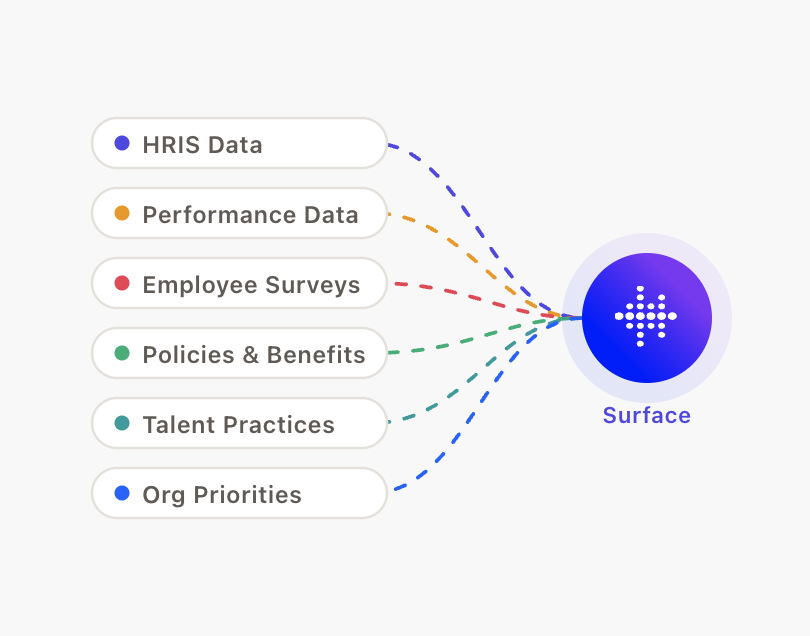
Paradigm’s AI-native platform, Surface, closes this gap by connecting HRIS, engagement data, performance data, and compensation benchmarks in one place. Rather than spending weeks manually pulling data from multiple systems, CHROs get a complete current-state picture before strategy planning begins. This ensures the audit acts as a starting point, not a multi-week project.
Step 2: Align with Business Strategy and Get Specific
Don’t just align HR to the business. Get specific:
- What are the CEO’s top three priorities for the next 12 months?
- What must the workforce do differently to achieve them?
- What talent capabilities are required that don’t yet exist?
Every piece of writing on HR strategy mentions business alignment, yet very few explain how to have the conversations that make it concrete. Start with the outcomes the CEO is accountable for, then trace those back to the talent capabilities that enable them.
Step 3: Benchmark Against Peers
Understanding your current state is only useful in context. Is your time-to-fill competitive for your talent market? Are your engagement scores low for your industry or typical for a post-restructuring environment? Benchmarks are how you convert data into decisions.
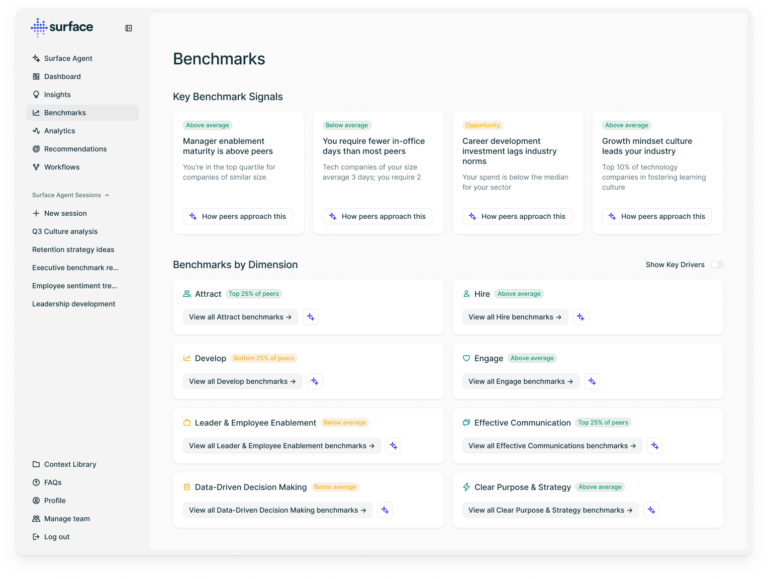
Surface delivers Paradigm’s proprietary benchmarks, built from 15+ years of work with organizations across industries, directly within the platform. CHROs get the context they need without commissioning a separate benchmarking study and waiting months for results.
Step 4: Identify and Prioritize Gaps
Not every gap deserves equal investment. Prioritize based on three questions:
- Which gaps are most directly connected to business outcomes?
- Which are most likely to compound if left unaddressed?
- Which have the highest-confidence interventions available?
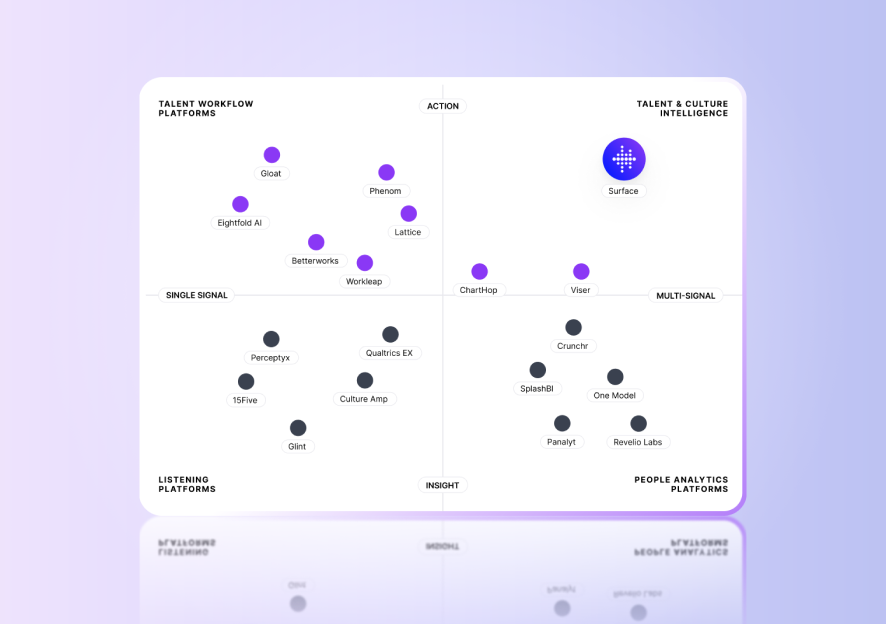
A useful frame is a simple two-by-two: impact on business outcomes on one axis and confidence in the intervention on the other. Invest first in high-impact, high-confidence gaps. Don’t let internal popularity drive prioritization.
Step 5: Build the CEO and Board Narrative
Your HR strategy doesn’t just need to be good. It needs to be legible to a board that thinks in business outcomes, not HR programs. This step is absent from nearly every guide on HR strategy development, which is exactly why it matters.
Translate every major initiative into a business outcome metric using this format:
- Problem
- Investment
- Expected outcome
- Measurement plan
For example:
- Problem: Retention risk is concentrated in the 18- to 24-month tenure cohort.
- Investment: We’re investing in a structured onboarding extension and 90-day manager check-in.
- Expected outcome: We project a 15% reduction in first-year attrition, representing [X] in avoided recruiting and ramp costs.
- Measurement plan: We’ll measure it quarterly against cohort attrition data.
Lead with the outcome. Follow with the mechanism.
Step 6: Set a Monitoring Cadence, Not Just Annual Metrics
The difference between a strategy that succeeds and one that gets shelved lies in the monitoring cadence. Set a quarterly check-in cadence that connects leading indicators, including engagement trends, mobility rates, and pipeline health, to the strategy’s core bets.
Don’t wait for the annual review to find out something isn’t working. Surface maintains your feedback loop after the strategy launches, highlighting leading indicators as they shift so adjustments happen in the quarter instead of after the annual review.
See how Surface keeps your strategy connected to real-time people data and provides the benchmarks you need to understand where to focus first.
What Great HR Strategy Looks Like in Practice
The difference between a strategy that holds and one that stalls usually shows up in the data.
When a global private equity firm came to Paradigm, it brought a specific challenge: it had built a strong internal culture and wanted to extend that discipline across dozens of portfolio companies. The problem was scale, or how to assess people processes, benchmark progress, prioritize action, and report credibly to boards and executive teams across organizations at very different maturity stages.
Using Paradigm’s proprietary benchmarks and AI-native tools, each portfolio company gained access to a maturity assessment, analytics dashboards, and peer benchmarks. Leadership teams could see exactly where they stood, which gaps to prioritize, and how their trajectory compared across the portfolio year over year.
The results compounded over time. Of the companies that stayed in the program for multiple years, 93% improved their maturity scores, with an average annual gain of nine percentage points. Companies that participated for three consecutive years scored 15 percentage points higher across all culture domains than those that joined for only one year.
As one Chief People Officer put it: “It’s such a pragmatic list of action items. There are a lot of statistics and insights that were compelling and helpful to present to the board and to our CEO.”
That last detail matters. The data didn’t just guide internal decisions. It built the board narrative, turning culture progress into a reportable, auditable business metric.
CHRO HR Strategy Checklist
Use this checklist to pressure-test your strategy across all three phases of HR strategy development:
Phase 1: Before You Build
- Pull current-state data from all key sources: engagement, HRIS, attrition, and performance.
- Connect data sources in a single platform, such as Surface, to eliminate manual stitching before strategy planning begins.
- Identify your CEO’s top three business priorities for the next 12 months.
- Benchmark key metrics against industry peers.
- Name the top three gaps between current capability and business requirements.
Phase 2: While You’re Building
- Connect each initiative to a specific business outcome.
- Prioritize initiatives by impact and confidence in the intervention, not internal popularity.
- Draft the CEO and board narrative using outcome language instead of program language.
- Assign an owner for each initiative and set a 90-day milestone.
Phase 3: After You Launch
- Schedule a quarterly monitoring cadence with the right data inputs.
- Identify leading indicators for each major initiative.
- Establish a process to adjust or deprioritize initiatives that fail to produce expected results.
How Paradigm Helps CHROs Build Smarter HR Strategies
Most HR strategies fail for two reasons:
- They’re built on incomplete, siloed data.
- They lack a feedback loop after launch.
Surface closes both gaps, connecting directly to the framework steps outlined above.
When auditing your current state, Surface replaces the manual stitching of HRIS, engagement, attrition, and performance data, providing a complete picture before strategy planning begins.
When benchmarking against peers, Surface delivers Paradigm’s proprietary benchmarks natively, contextualizing your data without the need for a separate study.
Surface also helps maintain a monitoring cadence, keeping the feedback loop running after launch and surfacing leading indicators in real time.
CHROs who build their annual talent roadmap with Paradigm and Surface spend less time assembling inputs and more time making decisions. And when the strategy needs to shift, they see the signal in time to act.
Build for Clarity, Not Complexity
HR strategy development is a data discipline. The CHROs whose roadmaps actually drive outcomes are the ones who’ve built a system for understanding what’s happening, benchmarking it against what’s possible, and adjusting continuously.
The organizations that will attract and retain the best talent in the next three years aren’t the ones with the most sophisticated HR frameworks. They’re the ones that see their organization clearly and act on what they see.
Discover how Surface gives you the connected people data and peer benchmarks to build an HR strategy that holds up in CEO conversations and the quarters that follow. Get in touch with us to request your free Surface demo.