
Employee Listening & Culture Data
How to Bridge the HR Insight-to-Action Gap (It's not another dashboard)
Joe
·

HR technology companies have spent the last decade convincing you of one thing: they help you understand your people. Engagement platforms can flag sentiment declines before they become retention problems. Analytics tools can predict regrettable attrition before it happens. Performance management tools can track goals, achievements, and scores. But here’s what they don’t do (yet): help you act on the insight.
Here’s what typically happens at every company, big or small, public or private. Survey results come in. The deck gets built. Leadership aligns on priorities. And then the actual work of responding, drafting policies, building action plans, and coordinating with managers falls on a team that’s already stretched thin. It takes weeks, months- sometimes it doesn’t happen at all. Two quarters later, the insights are still sitting in a slide deck, and it’s time to start planning for the next survey.
This is the insight-to-action gap.
Talent leaders have more insights than they know what to do with, but struggle to turn dashboards into better performance.
Why the Market Hasn’t Solved This
When you map the HR technology landscape around what data a platform can see and what it can do with that data, a pattern quickly emerges.
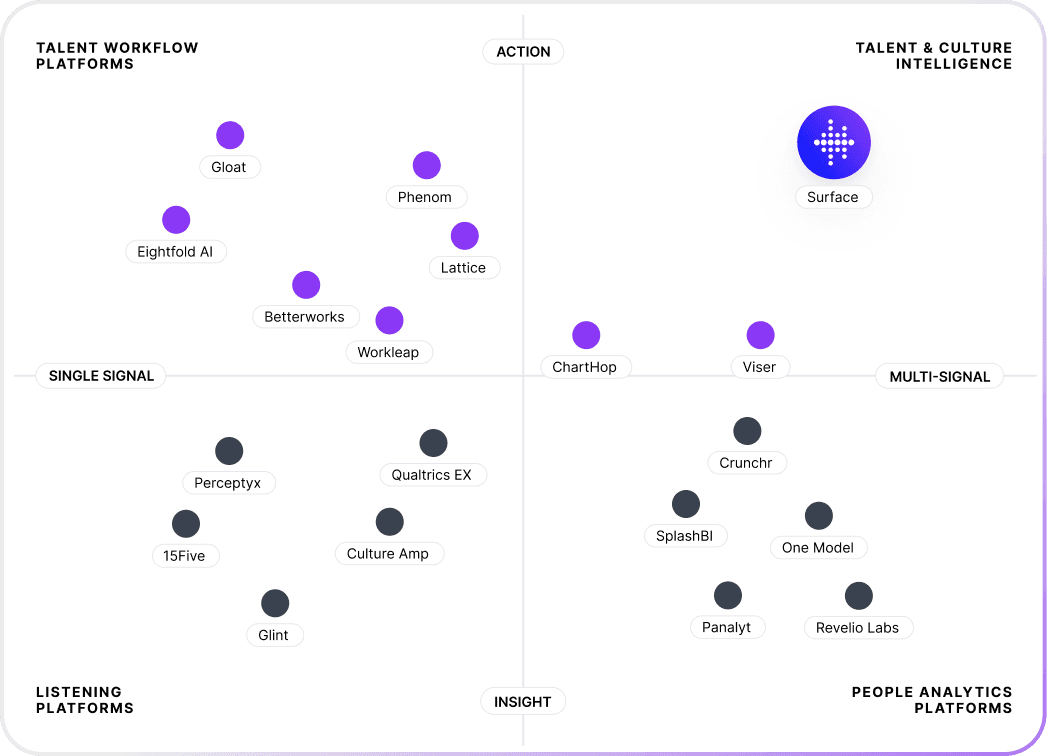
The X-axis is the breadth of signals or data sources. On the left are platforms built around a single data source, usually employee surveys or skills. On the right are platforms that pull together multiple signals: HRIS data, performance data, recruiting data, and basic benchmarks like time-to-fill and compa-ratio. The further right you go, the more interesting the organizational data becomes.
The Y-axis is what the platform does with those signals. At the bottom are tools that surface data and leave interpretation and action to you. At the top are platforms that can actually produce work: recommend roles, draft policies, build action plans, write communications, etc.
The market has clustered into three distinct zones and each one represents a different kind of tradeoff.
In the upper left are Talent Workflow Platforms: tools like Lattice, Phenom, and Eightfold. They’re excellent at driving action, but within narrow, specific workflows. They see one slice of the organization and execute well on it, but they don’t have the full picture.
In the lower left are Listening Platforms: Culture Amp, Glint, Qualtrics EX. They’re built around a single signal, most often employee surveys. They’ve expanded over time, but the survey remains the center of gravity, shaping both what they can see and what they can respond to.
In the lower right are People Analytics Platforms: tools like Crunchr and One Model. They pull together rich, multi-source data and surface meaningful patterns. But they stop at insight. What you do with that insight is still up to you.
The top right is nearly empty. That’s where you’d find a platform that combines multi-signal insights with the ability to translate those insights into strategy. Finished, ready-to-use work products that are backed by data, compliant, and built by domain experts.
Some companies are trying to get there. Visier and ChartHop are both pushing into the upper right from the multi-signal data side. But they’re legacy platforms built by data experts, not necessarily HR experts. They are bolting on AI capabilities after the fact, which means significant implementation overhead, integration complexity, and AI reasoning on top of the old architecture rather than being built into the foundation. It’s a fundamentally different approach than building AI-native from day one.
What “Action” Really Means
Before we talk about solutions, it’s worth being specific about what “action” actually looks like in sensitive HR work. For example, a tool that tells you your manager’s effectiveness scores are trending down is just giving you a diagnosis. A platform that combines insight and action will look like this:
Insight: Your manager effectiveness scores are down 8 points versus peers, driven primarily by gaps in communication and enablement among managers in your Engineering function.
Action: Here is a tailored manager training curriculum, a communication plan to roll it out, manager talking points for their skip-level conversations, and a 90-day timeline with clear ownership.
This is a completely different category of tool, and it requires the following combination of inputs to operate:
A complete view of the organization. Not just survey scores, but HRIS data, performance data, policies, benefits, and the institutional knowledge that shapes how your culture actually works in practice. The kind of context that usually lives in people’s heads and never makes it into any system.
Real expertise. Not generic best practices you can find on Google, but a deep enough understanding of what actually works across different types of organizations to know that the same pattern can require very different responses depending on the context.
Execution built into the platform. Not just identifying issues or suggesting next steps, but producing the actual deliverables: the policy draft, the board deck, the change communications package, the action plan with owners and timelines.
This Is What Surface Was Built to Do
Surface is the only AI-native people intelligence platform built specifically for this gap.
Surface pulls together HRIS data, engagement surveys, performance metrics, exit interviews, policies, benefits, and institutional knowledge—the unwritten talent practices that shape how your organization actually operates that exists in your team’s heads but has never lived in any system—into a single intelligence layer.
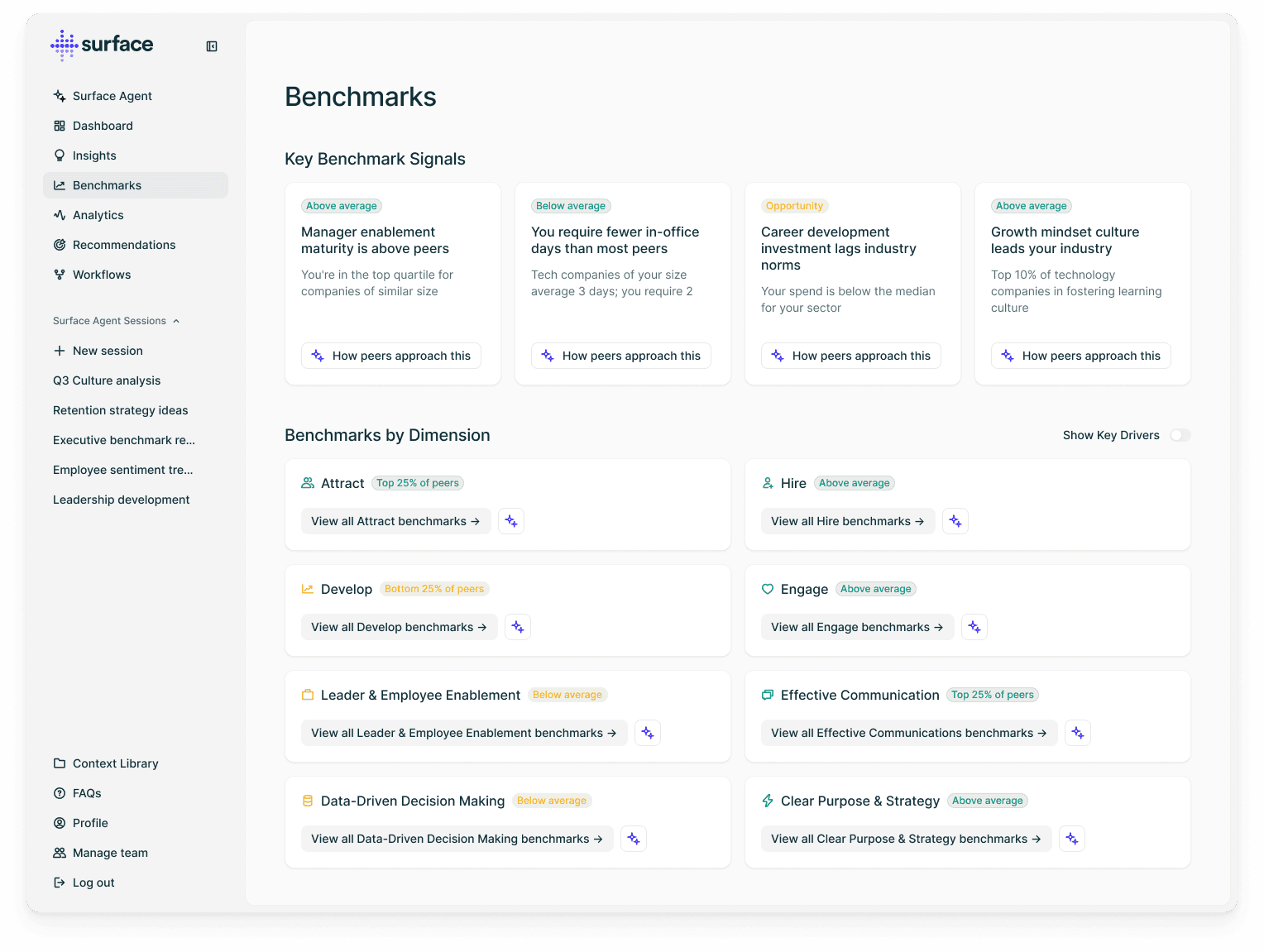
From there, Surface benchmarks you against peers on things most companies have never been able to benchmark. Not just compensation, but how your parental leave compares in practice, how your performance review approach stacks up, and whether your onboarding is above or below what peers are doing. These benchmarks are powered by Paradigm’s proprietary data, built from more than a decade of work across companies of all sizes and sectors. It’s the kind of contextual knowledge that generic AI simply doesn’t have.
But the real distinction is what happens next.
The Surface Agent doesn’t just respond to questions with generic frameworks. It produces work your team can use immediately.
Here’s what that looks like in practice: Imagine your engagement survey just closed. Your enablement scores came back 8 points below peers, and you ask Surface what to do. Instead of a high-level framework, it produces:
A prioritized analysis of the specific drivers underperforming in your organization
A 30/60/90 plan to address those gaps
A manager training curriculum tied to the plan
A full change communications package: the all-hands email in your CEO’s voice, manager talking points, a FAQ for impacted employees, and a Slack message template for direct managers.
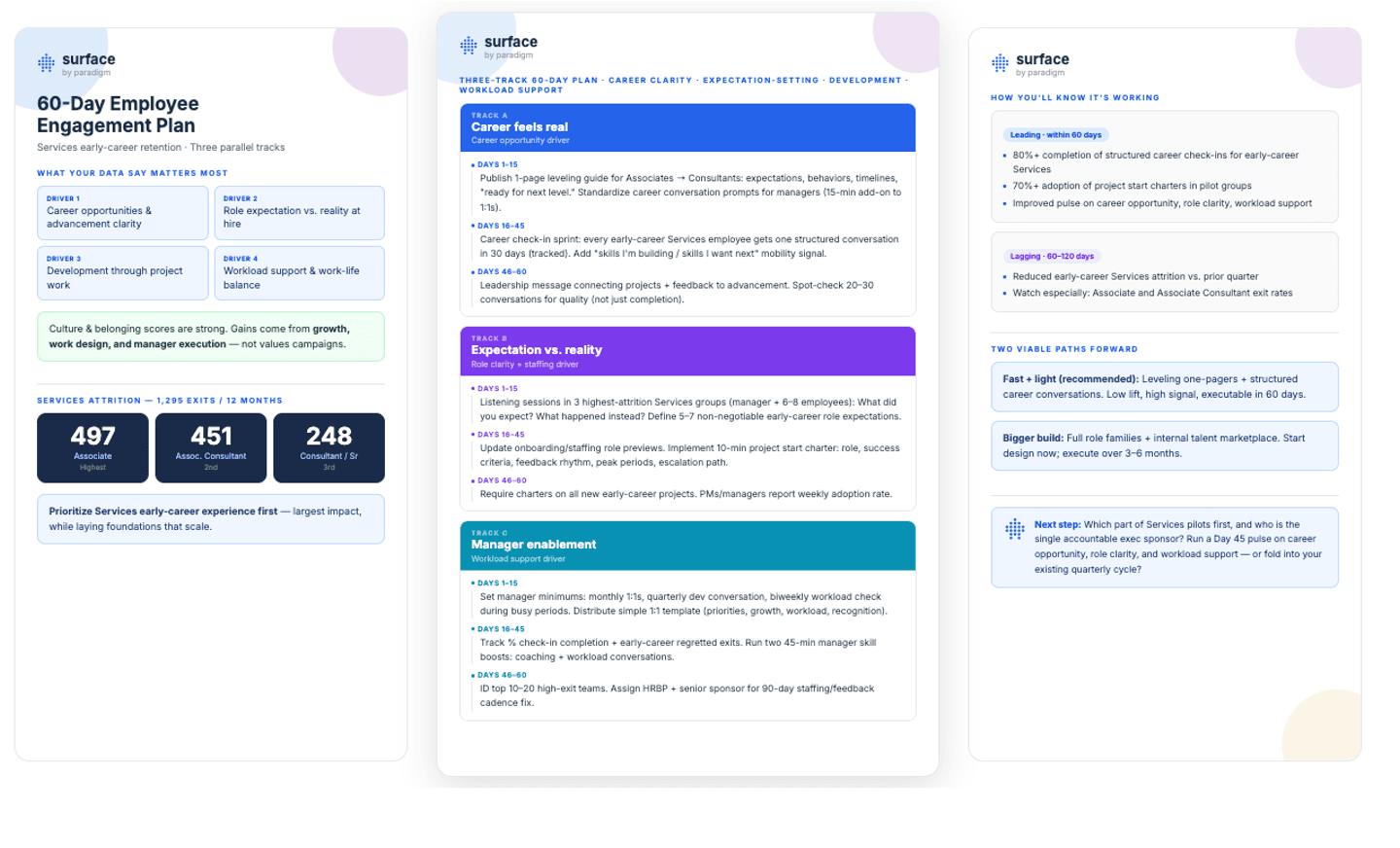
That output is ready for review. It’s the difference between a tool that makes you feel like you’ve just identified the problem and one that actually moves the work forward.
The same is true for board reporting, which consumes enormous amounts of talent team bandwidth every quarter. Describe what the board needs to see, and Surface produces a first draft with the right data, peer comparisons, and a narrative that connects your talent strategy to business outcomes that’s built from your actual organizational context, not a generic template.
Why It Had to Be Built by Paradigm
Some companies will try to build the solution on their own using a generic LLM. But try dropping a complex HR query into Claude and see what it produces. It might not be half bad, but dig two layers deeper. That’s where the outputs drift farther and farther away from a reflection of the real business problem.
Over twelve years, Paradigm has worked with thousands of organizations to understand how culture actually drives performance. That experience is natively embedded in Surface’s recommendations. When Surface tells you what to do about a declining engagement trend, it’s not giving you what a language model scraped from random management blogs. It draws on proprietary benchmarks and evidence-based frameworks built over a decade of real consulting work with thousands of companies.
The cost of getting something wrong isn’t just inefficiency, it’s trust. A poorly designed policy, a misread attrition signal, or a tone-deaf communication doesn’t just waste time; it undermines the credibility talent leaders depend on to do their jobs.
The Next Era of Talent Leadership
Most talent leaders already have the data. The problem has never been visibility. It’s the weeks of manual effort between an insight and a response that’s ready to deploy.
Surface closes that gap. Not by giving you more to look at, but by doing the work that sits between insight and impact. The organizations that pull ahead won’t be the ones with the most data. They’ll be the ones best equipped to act on it.
Request a Demo

Joe
Paradigm helps organizations solve their hardest people and culture challenges, through expert consulting and advisory work and Surface, our talent and culture intelligence platform.
View all articles
Newsletter
Expert perspectives on workplace culture, in your inbox
Keep reading
More insights

Employee Listening & Culture Data
Manager Effectiveness: How to Diagnose Where Your Managers Are Stuck
Learn how to identify manager effectiveness gaps using connected workforce signals, before they show up as exits. A diagnostic framework for CHROs and CPOs.

Employee Listening & Culture Data
Dashboards vs. Decisions: When to Use a People Analytics Platform—and When You Need Surface
People analytics platforms show what's happening. Surface shows you what to do about it. A framework for HR leaders who need both and know the difference.

Employee Listening & Culture Data
Portfolio Intelligence: The People Metrics Private Equity Firms Should Be Monitoring
PE firms monitor financial performance across the portfolio. Most don't have the same visibility on people metrics. Here's the framework and why it matters.