Paradigm
Paradigm’s Culture for Everyone Platform seamlessly integrates AI-enabled software with a team of experts to help companies build high-performance cultures where everyone can do their best work.
An M&A integration playbook for navigating the Culture Iceberg and powering high performance.
For the modern CHRO, a merger or acquisition is one of the ultimate tests. It’s a moment where the strategic value of an organization is either amplified or eroded. Yet, even if you scrutinize the financials and product synergies for months, the actual engine of your business, the people and the culture, is often left to fragmented data and reactive surveys.
People and culture are strategic business differentiators, not soft topics. In an M&A context, the difference between a successful integration and a failed merger comes down to intelligence: having the right data at the right time to make confident decisions about some of your most valuable assets.
We’ll outline how you can use AI-native people intelligence platforms like Surface to find harmony between merging workforces and move from siloed data to confident integration decisions.
Table of Contents
The M&A Reality: What’s Below the Surface
Phase 1: Establish a Single Source of Truth
Phase 2: Define What “Good” Looks Like
Phase 3: Bridge the Integration Gap
From Integration to Sustaining High-Performance Culture
The M&A Reality: What’s Below the Surface
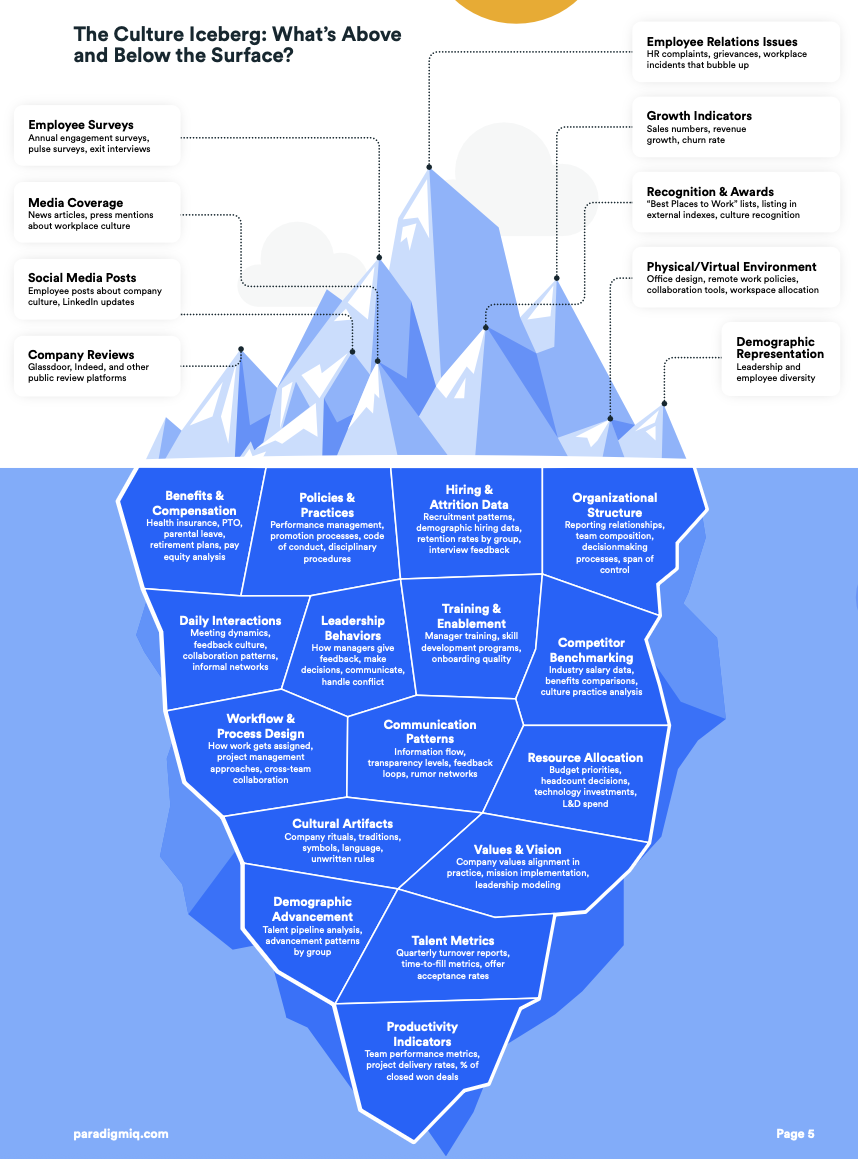
Most M&A integrations stumble because leaders only merge the tip of the iceberg—visible metrics like headcount, payroll, and titles. Meanwhile, the true integration battle happens below the surface, where unstated norms, hidden incentives, and different lived experiences can clash. The failure to account for these signals is often what causes high-value talent to churn and productivity to stall.
Below-the-surface signals are the “Culture Iceberg.” Learn how to identify these high-stakes culture indicators and confidently measure them in our guide to using AI to uncover culture insights.
In the urgency of an acquisition, it’s tempting to use general AI tools like ChatGPT or Claude as shortcuts to navigate this complexity. You might consider using them to merge conflicting employee handbooks or synthesize disparate culture policies. However, this creates a hidden tax.
The Hidden AI Tax: When General Intelligence Meets Specific Complexity
“General AI can’t tell you what’s excellent, leading, or risky for your specific merger.”
General AI is trained on everything, but it’s calibrated to nothing.
Because Claude, ChatGPT, and other general-purpose AI tools lack a reference class of proprietary benchmarks, they can’t help you navigate the nuanced reality of an integration. Instead, general AI optimizes for the average, which can regress your new organization toward a mean of mediocre HR policies.
In talent and culture work, the cost of an AI getting something even slightly wrong is trust.
A misread attrition trend, a poorly calibrated compensation benchmark, or an insensitive message doesn’t just waste time, it undermines the credibility talent leaders depend on. While general AI can tell you what’s possible, it can’t tell you what’s excellent, leading, or risky for your specific merger.
Harmonizing Culture Requires AI-Native Solutions
“AI-native tools allow talent leaders to become strategic architects and ensure the newly combined organization is built on a foundation of excellence.”
There’s a fundamental difference between a general-purpose chatbot and an intelligence layer designed specifically for the messy reality of talent and culture work. CHROs navigating the age of AI shouldn’t be asking “Can we build this?” but rather, “What do we need to own?”
Things to own include your strategy and your judgment about what’s right for your people and your unique organizational context.
Things not to own include the infrastructure that normalizes fragmented data, maintains proprietary benchmarks, encodes expert judgment, and manages AI risk.
To navigate the high-stakes complexity of an M&A integration, talent leaders don’t need an add-on AI tool, they need a purpose-built AI-native solution.
Here’s why an AI-native approach is the only way to successfully bridge the gap between two cultures:
Move Beyond the Internet Average
General-purpose AI tools are essentially digital libraries trained on the internet’s “lowest common denominator,” whether that’s Reddit, public blogs, or generic HR templates. They lack real visibility into what high-performance companies actually do.
Apply Contextual Judgment Over DIY Prompts
Relying on ChatGPT, Claude, or Gemini during an acquisition can create prompt fatigue for the user, who is tasked with uploading (and re-uploading) vast amounts of data and context, then training their agent. General AI also can’t distinguish a true best practice from a common mistake because it doesn’t have expert reference class to pull from.
Knowing when a system should raise a flag or stay quiet requires years of subject-matter expertise. An AI-native tool encodes this expert judgment, serving as a specialized interface that understands the nuance of your specific merger.
Bridge the Gap from Insight to Action
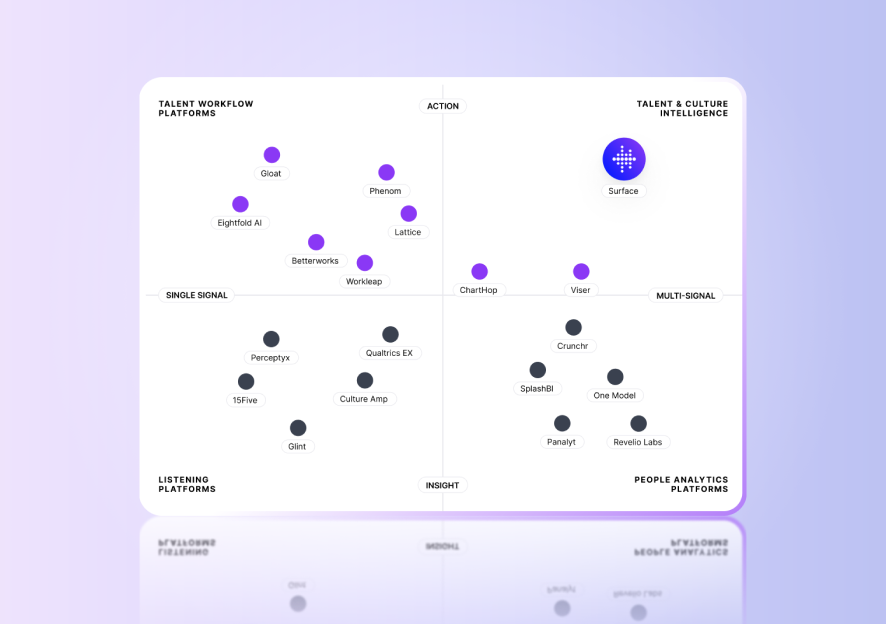
Most legacy HR tools fall into one of two traps: they capture multiple signals but stop at sharing insights, or they drive action on a single, isolated workflow only.
An AI-native tool does both. It ingests each company’s fragmented data to reveal the full Culture Iceberg, then uses AI to automate the heavy lifting, such as drafting unified policies or building executive attrition reports.
Deploying an AI-native intelligence layer enables you to move from being a data collector to a strategic architect, ensuring your newly combined organization is built on a foundation of excellence rather than an average of its parts.
Still building your own AI tools? Our free Talent and Culture AI Tools Checklist outlines what you need to know about designing, building, maintaining, and governing internal AI tools.
Phase 1: Establish a Single Source of Truth
During an acquisition, talent data lives in silos throughout both companies, scattered across legacy HRIS systems, ATS records, and static PDFs. Most teams waste weeks on manual spreadsheet wrangling just to get a baseline.
AI-native tools change that by providing a unified intelligence layer that does the heavy lifting for you.
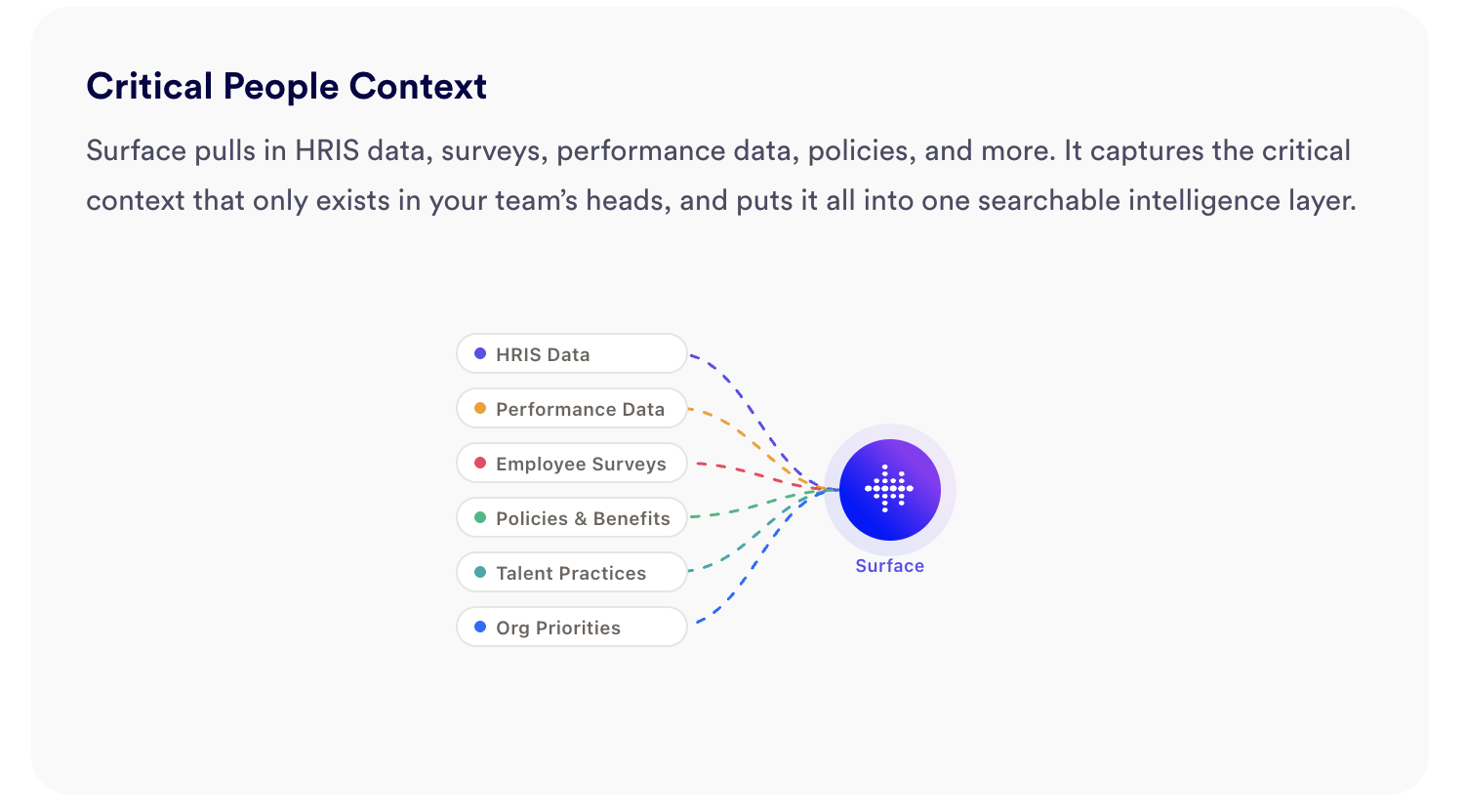
A tool like Surface can build a single source of truth for talent and culture, empowering you to move from insights to action.
Multi-Signal Data Unification
Legacy workforce analytics usually fail because they miss the bigger picture.
For example, a standard employee engagement survey might flag “lack of career growth” as a concern in an acquired department. In isolation, that’s just a data point, which is why Surface does more than merely report data. It unites information from both companies into one searchable foundation.
This includes data from your HRIS records, compensation tables, headcount metrics, employee handbooks, benefits guides, and even performance feedback. And with the Talent Practices Inventory, Surface also builds context around the unwritten reality of both companies.
Learn how to turn pulse checks into progress and get more from employee surveys.
The Talent Practices Inventory: Capturing the Unwritten Reality
Even with the best data, there’s a layer of culture that structured systems and handbooks simply don’t capture. The Talent Practices Inventory inside Surface provides this vital connective tissue.
While a handbook tells you what’s supposed to happen, the Inventory uncovers what actually happened. It uses a dynamic series of assessments, covering everything from leader enablement to inclusive practices, to capture the institutional knowledge that usually disappears during a merger.
Instead of forcing you to take a lengthy, static assessment, Surface prompts you to answer real-time questions as they emerge. This creates a continuously updated and dynamic understanding of the workplace that we call your Talent Practices Inventory.
By collecting these hidden details, the Inventory provides Surface with the rich context needed to understand the underlying drivers of your company’s culture. This can include context like:
- True resource allocation: Actual annual spend on professional development per employee, regardless of what the L&D budget line item says
- Lived management norms: How managers are trained to give feedback and whether 1:1s are a consistent reality or a theoretical exercise
- Operational nuance: The organization’s actual approach to conducting structured interviews, or how it recognizes and rewards invisible work like culture-building and mentorship
- Incentive alignment: Which employee resource groups (ERGs) exist, how much funding they receive, and whether leaders are truly held accountable for team health
By layering this inventory on top of your unified data, Surface doesn’t just show you what the merging organizations look like on paper. Instead, it reveals the unwritten rules and incentives that drive performance. This gives you the clarity you need to move from fragmented inputs to confident, strategic decisions.
Phase 2: Define What “Good” Looks Like
“Surface benchmarks non-public practices like parental leave policies, manager development spend, and onboarding efficiency.”
Once you’ve unified your data, you hit the next strategic hurdle: calibration. During an M&A, you aren’t just asking “What do we have?” You’re asking, “Is this actually excellent?”
Because they lack real-world engagement scores and industry context, legacy tools leave you guessing. Surface anchors your integration in proprietary industry benchmarks built from over a decade of work with thousands of organizations. We don’t just show you your data, we show you where you lead, where you lag, and where you’re at risk.
Assess Culture Maturity and Reconcile Policies
Mergers often force CHROs to choose between two conflicting sets of benefits and norms. Surface can help you reconcile these by benchmarking them against a peer reference class.
While many companies benchmark compensation, they struggle to benchmark other benefits, policies, and talent and culture practices. Surface allows you to compare non-public practices, such as parental leave, manager development investment, onboarding effectiveness, and more against industry leaders.
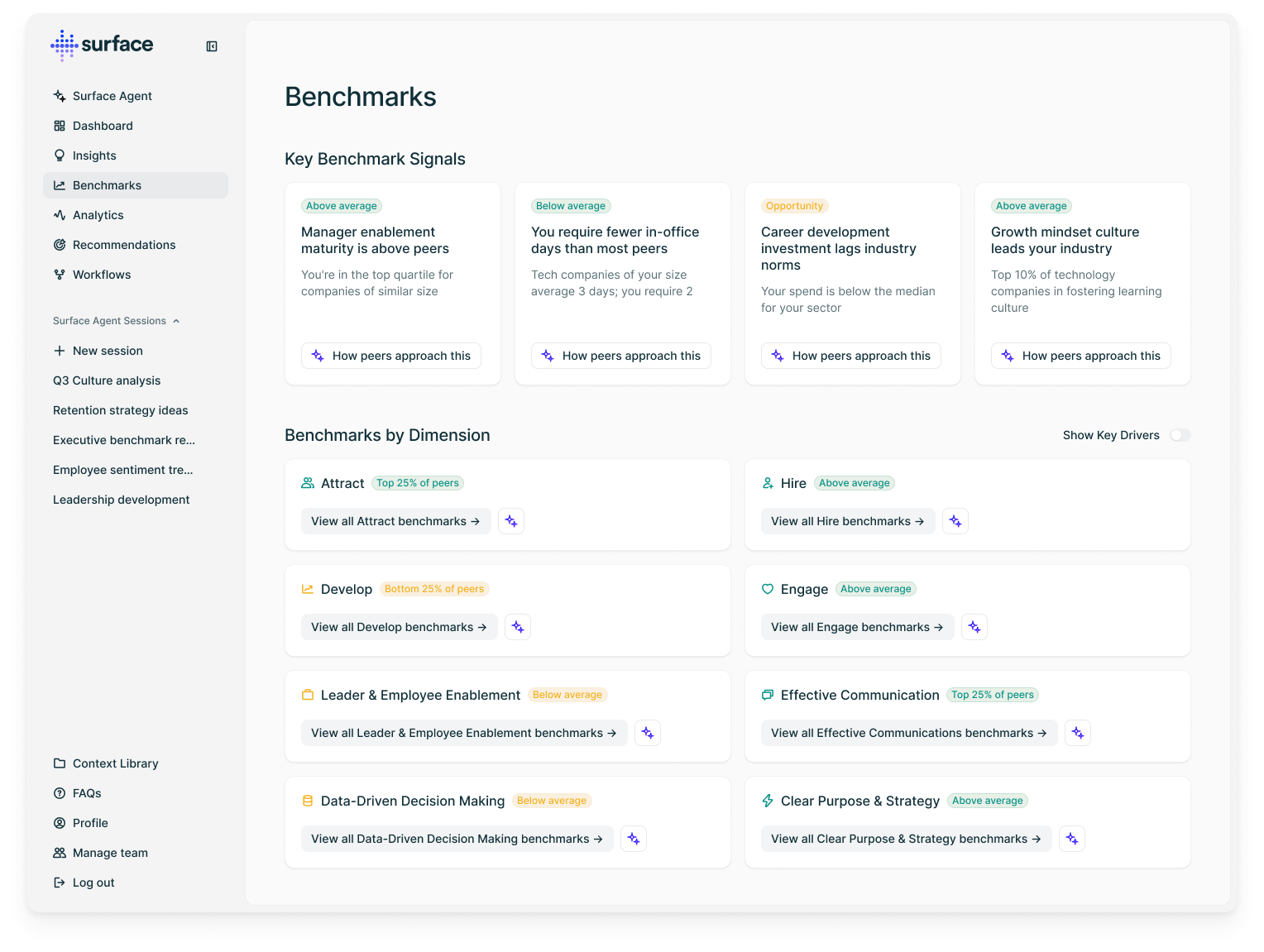
This broader view is essential for making strategic decisions when it’s time to reconcile policies. Instead of picking the cheaper or larger company’s policy, you can use Surface to identify which approach is more competitive and/or more likely to drive high performance.
Uncover Hidden Hotspots and Flight Risks
Aligning your policies is only half the battle. The real test of an integration is how your people react in the months that follow.
Acquisitions create anxiety, and left unmanaged, that anxiety drives attrition. A 2023 Deloitte study discovered that voluntary attrition jumps by more than 30% during M&A.
By cross-referencing your unified data with industry benchmarks, Surface identifies flight risks before they hit your bottom line. It shows you exactly which pockets of the organization are most exposed, so you can intervene before the talent you just gained walks out the door.
For example, if an acquired engineering department shows an 8% turnover rate, a general AI tool might call that “standard” and leave it at that. Surface compares that figure to proprietary peer data to reveal that, for a tech company of your new size, the industry median turnover rate is 15% and you can also expect a post-merger attrition bump, highlighting a critical hotspot that requires immediate attention. To take action, Surface might help you build a program focused on retention for that group, or flag the need to consider hiring in anticipation of attrition.
Move from Benchmarks to Action
During M&As, benchmarks are only as valuable as the action they enable. Knowing you’re likely to see a bump in post-merger attrition doesn’t solve the problem, it simply quantifies it.
The true power of Surface lies in its ability not just to identify the gap, but to bridge it. After flagging a risk, Surface’s Agent translates that benchmark into a prioritized next step.
For example, if your remote work flexibility lags the industry median, the Surface Agent calls attention to the issue and helps you draft a benchmarked Flexible Work Policy designed to stabilize your talent pool.
The Surface Agent also helps you understand potential risks, hotspots, and recommended actions, just like a trusted expert advisor.
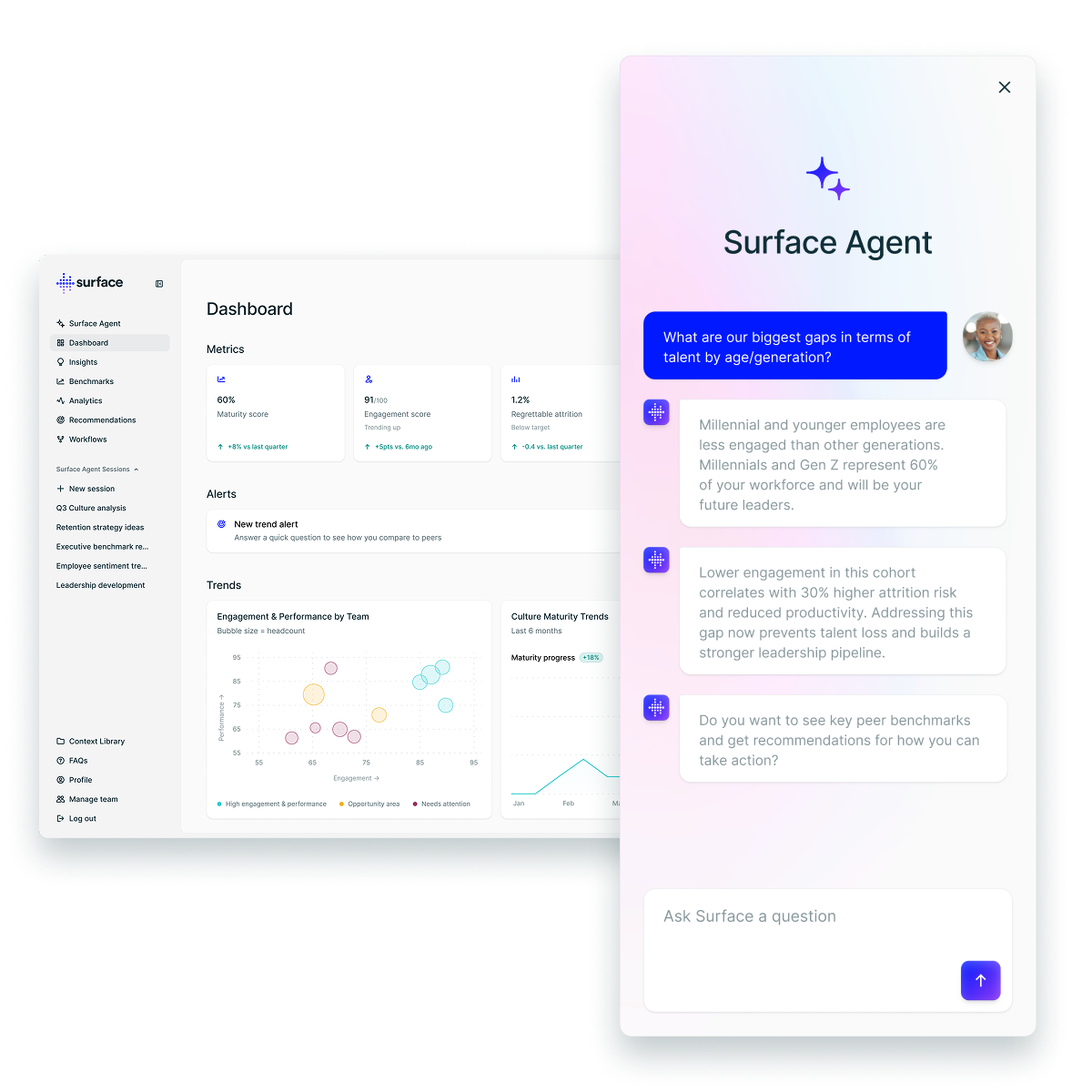
While the Surface Agent is easy to use and makes proactive planning seem effortless, its responses take into consideration the 12 years of expertise that our team at Paradigm has built. Think of the Surface Agent as an on-demand version of our team of executive advisors, people analysts, and execution partners.
Instead of just reviewing dashboards, you can turn to the Agent to ask questions about your data in real time and immediately get the work done.
Need to explore an unexpected trend? Ask the Agent to instantly build a custom chart visualizing attrition by department.
Need to move from insight to action? The Agent can quickly create the materials you need to move fast—from drafting a custom manager training curriculum to generating an executive board brief complete with peer benchmarks.
You stop wrestling with manual production and start making the confident, data-backed decisions that define the modern C-suite.
Phase 3: Bridge the Integration Gap
“Surface helps you move from raw data to fully drafted policies.”
In a high-stakes M&A, the strategy often fails in the last mile. Knowing you need to harmonize two workforces and cultures is one thing, but actually doing the work creates a massive operational burden that can stall even the best-laid plans. From drafting parental leave and remote work policies to communicating organizational and department-level change, unifying it all into a single set of policies is challenging, time-consuming work.
Instead of leaving your HR team to manually reconcile competing documents, you can deploy the Surface Agent to instantly execute the work for you. By simply uploading both companies’ policies and handbooks, the Agent automatically cross-references the materials and drafts a unified, best-in-class HR playbook.
That means you can quickly generate ready-to-use change communications packages and consolidated work policies tailored to the new organization’s needs, turning weeks of manual integration work into minutes of review
Build Unified Workforce Policies
Reconciling two conflicting sets of HR policies and benefits into a single, cohesive plan is a grueling task. Usually, it requires months of manual synthesis and legal back-and-forth.
Surface eliminates much of that friction to help you move from raw data to fully drafted, unified policies, including:
- Remote work, flexible work, and RTO policies
- Benefits and time off, including parental leave and PTO
- Employee handbooks
Harmonize Leadership
Policies aside, an M&A can lead to a clash of management styles and cultures. Surface helps you step in beforehand to build a system that ensures all legacy and newly acquired leaders align under a shared standard of excellence.
Instead of generic advice, the Surface Agent instantly drafts a comprehensive manager enablement plan tailored to the specific needs of your newly merged organization. To ensure your leaders are fully equipped to guide their teams through the transition, the Agent generates a ready-to-use toolkit that includes:
- Custom Training Plans: Targeted curricula and learning objectives designed to upskill managers on key integration themes, such as building team resilience, establishing a growth mindset, and facilitating inclusive meetings.
- Manager Tools: Practical, day-to-day resources—including skip-level talking points and guides for delivering fair and honest feedback during times of change.
- Change Communications: Ready-to-send templates, including employee FAQs, Slack messages, and all-hands emails, so leaders can confidently and consistently communicate with their teams.
Scale Communication
Consistent communication is key during any time of change, and during an M&A, it becomes essential for managing expectations, smoothing transitions, and reducing risk. Surface helps you draft messaging that ensures all legacy and new employees, managers, and executives are on the same page, including:
- An all-hands announcement email in your CEO’s voice
- Manager talking points and one-pagers
- FAQ documents for employees
- Slack templates for direct managers
Remember, it’s also critical to keep your board in the loop. While they may demand instant updates and answers, building a board deck after an acquisition usually takes weeks of data cleaning.
Surface helps you communicate quickly and confidently by generating board-ready briefings, attrition reports, and quarterly business reviews (QBRs) that connect your talent integration metrics, like retention in key departments, directly to the business outcomes the board cares about most and outline priority actions.
By moving from insights to action, Surface ensures you spend less time on manual document production and more time on the strategic work of leading your new organization.
From Integration to Sustaining High-Performance Culture
M&A integration represents the beginning of a new, combined organizational lifecycle. The most successful talent leaders understand that the initial close is just the starting point. Sustaining high performance requires moving beyond static integration plans and building a system that learns as you go.
Employ Continuous Calibration Over Static Maintenance
Too many organizations treat the post-merger period as a “wait and see” phase. Successful integrations require you to take action before Glassdoor reviews tank or top performers resign. Surface makes action easier by providing continuous, real-time calibration:
- Monitor the health of your new organization: Surface continuously assesses the culture maturity of your newly merged organization, tracking trends over time to see whether your integration strategies take hold or legacy frictions resurface.
- Scan for emerging risks: Our platform continuously scans your data to flag hotspots, such as a sudden drop in engagement or a spike in turnover intent, so you can intervene weeks before the issue becomes a systemic crisis.
- Generate targeted materials instantly: When a risk is identified, you don’t have to spend weeks figuring out how to respond. The Surface Agent actively executes the work for you by instantly producing the deliverables you need, such as change communications packages, unified workplace policies, and custom manager training curricula, so you can correct the course immediately.
Scale with Expert, Human-in-the-Loop Judgment
While Surface provides the AI-native intelligence to see your new organization’s hidden culture influencers, the most complex shifts still require a human touch. This is why the Paradigm system includes human-in-the-loop expertise:
-
- Navigate long-term change management: Our Expert Services team partners with you to facilitate dialogues with your newly merged executive team, provide hands-on support for evolving HR programs, and share strategic guidance grounded in our years of experience.
- Motivate employees and build resilience: We pair Surface’s insights with Reach, our embedded learning platform that delivers AI-powered coaching and nudges directly into your employees’ daily work. This helps you build the shared communication habits and resilience you need to make your new culture permanent.
Merging two companies leaves talent leaders with the heavy burden of ensuring excellence and protecting company assets. Don’t let distractions, like prompting a general AI tool over and over or fighting to understand data within a legacy system, hold you back.
Paradigm Surface offers a holistic system that unifies your culture data, helps you measure and understand it, and empowers you to take action.
Ready to see Surface in action? Explore how our platform can transform your next integration with a free Surface demo.