Our website uses cookies to distinguish you from other users of our website. This helps us to provide you with a good experience when you browse our website and also allows us to
improve our site. By continuing to browse our website, you’re agreeing to our use of cookies. For more information, please read our
Our website uses cookies to distinguish you from other users of our website. This helps us to provide you with a good experience when you browse our website and also allows us to
improve our site. By continuing to browse our website, you’re agreeing to our use of cookies. For more information, please read our


Paradigm
Paradigm’s Culture for Everyone Platform seamlessly integrates AI-enabled software with a team of experts to help companies build high-performance cultures where everyone can do their best work.
In modern business, human resources leaders face an imperative that extends far beyond compliance checkboxes and static dashboards. The need isn’t simply to measure what’s happened—it’s to influence how the organization behaves, how people engage, and how culture evolves.
Enter the next generation of people analytics: a model grounded in culture, performance, and inclusion. With solutions that go beyond monitoring metrics to reveal systemic bias and guide strategic talent and culture decisions, HR teams can now unlock actionable insights not just about what is happening, but about why, how, and what to do next.
Why now? Several trends are converging:
- Employee expectations are rising. People want work environments that value belonging, contribution, and growth.
- Hybrid and remote work have redefined culture. Connection and inclusion are more complex—and more critical—than ever.
- Business outcomes depend on collaboration. Performance hinges on how diverse voices innovate together, not just on headcount or cost metrics.
- Technology has matured. Unified, artificial intelligence‑enabled HR technology can now connect insights to action, meaning analytics can lead to real change.
In short: When analytics stop at dashboards, they stop short of impact. HR leaders ready to move beyond automation and compliance must reimagine how they use people analytics to drive culture transformation.
Main Takeaways
- People analytics isn’t just about tracking—it’s about transforming. Paradigm reframes analytics as a tool for culture change, not just compliance or reporting.
- Data must reflect lived experiences, not just demographics. Structural data (e.g., pay, promotions) needs to be combined with experience-based insights (e.g., inclusion, feedback) to accurately reflect reality.
- Disaggregate and contextualize everything. Break down data by identity to uncover hidden inequities and explore why patterns exist. Metrics alone don’t tell the full story.
What Is People Analytics?
At its most basic, people analytics is the practice of collecting and analyzing workforce data to improve business outcomes. Think engagement surveys, attrition rates, promotion timelines, and demographic tracking. It’s been a core part of human resources for years.
Typical use cases for people analytics include:
- Employee turnover forecasting
- Performance and productivity metrics
- Recruiting funnel metrics (e.g., time to hire, cost to hire)
- Employee satisfaction rates
- Predictive analytics and workforce planning
- Pay equality
Most organizations stop here, using people analytics only for measurement—not transformation. This limits its usefulness in three key ways:
- It’s retrospective, reporting on what already happened instead of what to change next.
- It’s decontextualized, lacking insights into why patterns exist.
- It’s disconnected from employee voice, leadership accountability, and daily decisions.
In contrast, Paradigm gives people analytics a new, better approach with an AI intelligence layer that improves and operationalizes it. It helps leaders connect the dots between data and culture to design strategies that address the true drivers of high performance. This leads to a deeper level of understanding that reveals not only what is happening, but the underlying forces that explain why.
From Metrics to Meaning: A New Model for People Analytics
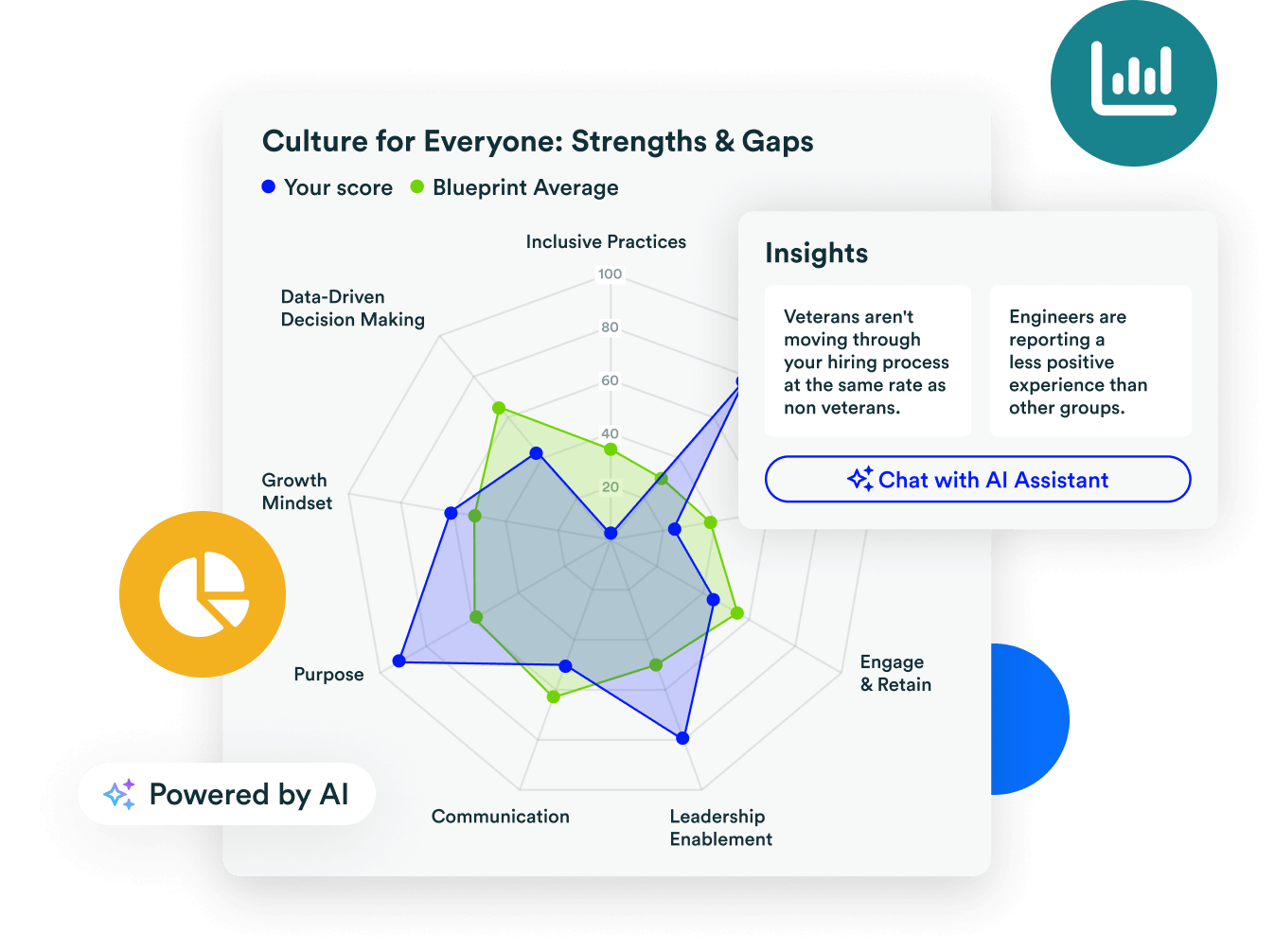
To drive real culture change, people analytics must answer the following critical questions:
- “What happened?”
- “What are we doing about it?”
- “How are we different because of it?”
This requires a new framework—one that treats culture not as an abstract “nice-to-have” but as something operational, measurable, and strategic.
Organizations can move beyond surface-level metrics and measure culture in ways that meaningfully connect inclusion, performance, and behavior by focusing on the following pillars.
Objectivity: Are Decisions Fair and Consistent?
This pillar evaluates whether systems and processes treat people equitably. It examines whether decisions—such as promotions, hiring, and performance evaluations—are transparent, consistent, and free from systemic bias. Analytics aligned to objectivity might include:
- Promotion rates by demographic within comparable roles
- Consistency in performance reviews and ratings across teams
- Compensation variance for equivalent work
By bringing structure to fairness, organizations turn data analysis into a lever for integrity, accountability, and informed decision-making.
Belonging: Do People Feel Valued, Included, and Connected?
Belonging is the experience of being valued, accepted, and able to bring your whole self to work. It not only matters to employees—it also brings a host of business benefits for organizations. According to research by BetterUp, workplace belonging increases job performance by 56%, reduces turnover risk by half, and decreases employee sick days by 75%.
Analytics under the belonging pillar might draw on:
- Survey data (e.g., sense of inclusion, psychological safety, well-being)
- Network data (e.g., who collaborates with whom)
- Retention and engagement statistics, especially for underrepresented groups
In Paradigm’s model, culture isn’t just about diverse representation. It’s about creating an environment where people feel accepted, engaged, and empowered to contribute.
Voice: Are Ideas Heard and Credited?
Voice matters: Employees want to feel that their ideas and feedback are recognized and valued. Yet research from The Workforce Institute at UKG shows that 86% of employees don’t believe their voices are heard fairly or equally. Even worse, 63% feel their voice has been ignored in the past, and more than one in three would rather quit or switch teams than voice their true concerns to management.
Analytics can measure employee voice through people data, such as:
- Who speaks up in meetings
- Whose ideas receive input and follow-up
- Whose feedback leads to action
- Whether team members across identity groups feel they can influence decisions
By focusing on voice, data analytics can go beyond representation to capture influence. This might include responses from employee surveys on psychological safety, analysis of recognition systems, and correlations with business results.
Growth: Is Development Equitably Supported?
Growth is about opportunity. Are all employees equally able to access development, mobility, mentorship, upskilling opportunities, and meaningful roles? Analytics might look at:
- Internal mobility rates
- Time to promotion
- Access to learning
- Manager support for growth
- Retention of talent from diverse groups
In Paradigm’s framing, growth is neither optional nor privileged. Instead, it’s an integral part of inclusion and performance.
When HR leaders frame people analytics using these four pillars, they shift from metrics that simply “show the state” to those that reflect lived experience and enable actionable change. Analytics become strategic, signaling where the organization is performing (or underperforming) on inclusion and high performance while highlighting specific levers of change.
Common Pitfalls in People Analytics (and How To Avoid Them)
To make data truly meaningful, it’s important to understand the common challenges in people analytics and how to address them. Below are a few situations you may run into, along with practical solutions.
Pitfall 1: Gathering Lots of Data but No Insights
You can collect as much employee data as you want, but if you don’t know how to act on it meaningfully, it isn’t doing you any favors. For example, a mid‑sized tech firm might invest in dozens of visualization dashboards to track manager effectiveness scores, turnover by role, and employee engagement by team. But if leaders only glance at them once a quarter and no real decisions follow, potential insights sit idle.
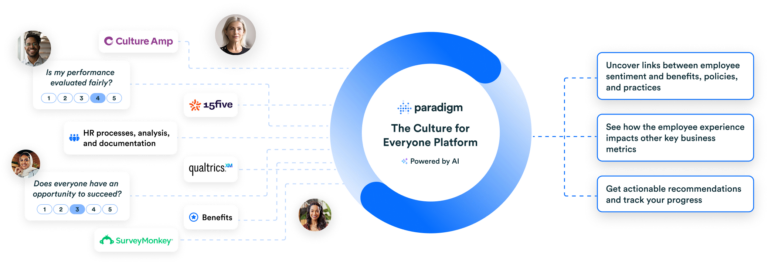
Solution: Link analytics to action. Ask: “If this insight is true, what will we do differently?” Use data as a conversation starter with leadership, not just an information dump. Paradigm’s Blueprint platform combines a helpful AI assistant with expert guidance to translate insights into concrete next steps.
Pitfall 2: Focusing on Representation Alone
Many organizations fall into the trap of simply tracking headcount for underrepresented groups. While representation is important, it doesn’t capture whether people feel included, whether decisions are fair, or whether systems foster growth.
Solution: Use the four-pillar model to layer in experience and behavior metrics, such as belonging, voice, and growth. For example, instead of measuring only the “percentage of women in leadership,” consider the “percentage of women who report feeling their ideas were heard by senior leaders.”
Pitfall 3: Data Silos and Poor Integration
If data sets live in disconnected systems—an HRIS here, survey tool there, learning platforms elsewhere—you’ll struggle to draw meaningful conclusions. For instance, you can’t link sense of belonging data to specific teams or demographics if your HR system and employee feedback tools don’t communicate.
Solution: Use a platform like Paradigm to unify your analytics capabilities. Build an integration roadmap to connect demographic, engagement, performance, development, and turnover data for deeper insights and more targeted action.
How Leading Companies Are Evolving Their People Analytics
Despite executive orders and headlines announcing a scale-back of diversity, equity, and inclusion (DEI) campaigns, Paradigm’s 2025 Benchmarking Study found that most companies aren’t retreating from their initiatives to build cultures where everyone can thrive. Instead, they’re evolving their HR strategies to make these programs more resilient and actionable.
According to the report, more than 85% of companies continue to collect employee and applicant demographic data to understand how employee sentiment, promotions, and hiring might vary across groups. Additionally, 90% are actively investing in creating fairer decision-making processes, and 91% are prioritizing intentional efforts to attract diverse talent.
Take the Institute for Health Metrics and Evaluation (IHME) as an example. The global health company partnered with Paradigm for help building a more diverse and inclusive culture. Together, Paradigm and IHME identified key barriers to inclusion and belonging, strategies to alleviate those obstacles, and a roadmap designed to drive measurable impact.
As a result, employees reported that issues related to workplace culture are now openly discussed, with a mean of 4.24 out of 5 on a recent engagement survey. IHME also created an internal council and hired a chief diversity officer to continue this work.
How To Build an Inclusive People Analytics Strategy
If you’re a senior HR leader ready to use people analytics to drive culture change (not just generate reports), here’s a tactical roadmap tailored to you.
1. Start with Purpose
Begin with intent. Define what you want your workplace culture to achieve—not in lofty terms (e.g., “be more inclusive”) but in concrete outcomes. Consider what success looks like when objectivity, belonging, voice, and growth are embedded in your organization, and determine how analytics can help you operationalize that culture.
Questions to ask yourself and your people analytics team include:
- What cultural behaviors and systems do we want to see?
- Which leadership behaviors matter most for driving impact?
- Which experience or skills gaps might be limiting employee performance or retention rates?
- How will we know when we’ve achieved a more inclusive and high‑performing culture for everyone?
Starting with purpose ensures that your analytics aren’t simply about compliance, benchmarking, or reporting, but are tied directly to culture and business impact.
2. Choose Metrics That Reflect Reality
Instead of tracking only what’s easy, choose metrics that reflect lived experiences, behavioral systems, and structural equity. To get an accurate picture of inclusion, use a blend of structural (e.g., representation, promotion rates), experiential (e.g., belonging scores, voice metrics), and outcome-focused (e.g., employee retention, internal mobility, performance) metrics.
Here’s a brief contrast:
| Traditional Metric | Inclusive Culture Metric |
| Turnover rate | Turnover rate by demographic group, team, or role, combined with reasons related to employee experience and voice |
| Time to hire | Time to hire by demographic group, team, or role, plus percentage of candidates offered cross‑functional mobility |
| Engagement survey overall score | Belonging and voice survey items broken out by identity group, team, role, or tenure |
| Learning completion rate | Learning completion rate and internal mobility/growth opportunities tracked across identity groups, teams, and roles |
Selecting metrics this way positions analytics to uncover deeper systemic and behavioral issues rather than just surface-level representation. It positions people management leaders to take action that truly moves culture forward.
3. Disaggregate the Data
One of the most powerful levers in inclusive analytics is disaggregation: breaking down data by key identity groups (e.g., race/ethnicity, LGBTQIA+, gender, disability, veteran status) and other relevant dimensions (role level, location, tenure). This uncovers hidden inequities that averages can mask and unlocks targeted action.
Even today, many organizations still fail to fully disaggregate HR metrics to identify specific friction points. To avoid this:
- Identify key groupings for breakdown (e.g., by demographic + role level + geographic region)
- Ensure your HR systems support linkage and detailed reporting (HRIS + survey + performance management systems)
- Confirm you have sufficient sample sizes and statistical confidence for accurate interpretation
- Use disaggregated insights to design targeted interventions (e.g., mentoring for underrepresented groups who report low belonging; onboarding redesign for remote new hires)
Disaggregated analytics signal where systems are failing certain groups, which provides the foundation for targeted cultural change.
4. Contextualize Everything
Data alone doesn’t tell the full story. Metrics without context can lead to misdiagnosis and misguided interventions. For example, a low voice score in a department might reflect remote work challenges, time zone differences, or specific leadership practices. A high promotion rate might obscure inequities in opportunity distribution across demographics or teams.
Culture lives in what gets rewarded, whose voices get heard, and how decisions get made. Questions to ask when contextualizing include:
- Which recent business changes (e.g., growth, remote/hybrid shift, new initiatives) might impact these metrics?
- Which processes, leadership behaviors, or structural practices could be driving these results?
- Which conversations and qualitative data (e.g., focus groups, interviews) support or contradict what we see quantitatively?
- What are the underlying root causes (not just the symptoms) of the patterns we’re observing?
Only by anchoring metrics in context can HR leaders move from “we have a score” to “we understand why, and we’re taking corrective action.”
5. Build Feedback Loops
Analytics must be dynamic, not static, and inform continuous improvement, not just quarterly reporting. One‑off snapshots don’t build culture; iterative learning does.
Paradigm’s model supports employee voice as a cultural and performance driver. Feedback loops turn analytics into a living part of your culture’s operating system.
Follow these key practices to build effective feedback loops:
- Embed analytics discussions in leadership forums—executive teams, talent acquisition committees, and HR business partner meetings—and ask, “What are the signals telling us?”
- Use the data to design interventions and measure outcomes, then surface new insights in follow‑up cycles.
- Include employee voice mechanisms, such as pulse surveys and focus groups, to validate and enrich quantitative insights.
- Connect learning and leadership interventions back to analytics (e.g., track changes in belonging or growth scores after manager training).
6. Create Shared Accountability
HR analytics must drive behavioral change and leadership accountability. Inclusion isn’t optional—it’s operational. If insights remain siloed in HR, the business won’t change.
To embed shared accountability, follow these best practices:
- Ensure dashboards aren’t exclusive to HR—include views for managers, business leaders, and other stakeholders.
- Tie culture metrics (e.g., belonging, voice, growth) to leadership goals and performance discussions.
- Use analytics to guide leader development programs (e.g., which leaders would benefit from coaching on inclusive behaviors?)
- Communicate workplace culture progress transparently (while safeguarding data privacy) across the organization.
- Link people analytics outcomes to business results (e.g., innovation speed, retention of top talent, employee net‑promoter scores).
When analytics drive leadership behavior, they shift from “nice to know” to “must know—and must act.”
Suggested resource: Paradigm’s Inclusive Leadership Self-Assessment helps leaders understand their behaviors and provides specific, concrete guidance for fostering inclusion.
People Analytics Is Culture Work
People analytics isn’t about data for data’s sake. It’s a strategic lever for building fairer, higher-performing, more inclusive workplaces.
With the right framework—centered on objectivity, belonging, voice, and growth—people analytics become the operational backbone of cultural transformation. When you tie integrated, disaggregated, and contextualized data to action, you move from dashboards to data-driven decisions and from insights to interventions.
Paradigm’s Culture for Everyone platform provides the people analytics tools you need to get there. You can unify workforce data, measure the maturity of your workplace culture, generate actionable recommendations, and link analytics to learning and leadership development.
Looking to evolve your people analytics strategy? Paradigm partners with forward-thinking HR leaders to turn data into meaningful culture change. Let’s talk.
FAQs About People Analytics
What are the benefits of people analytics?
People analytics helps organizations make better decisions using data about their workforce. It uncovers patterns in hiring, performance, retention, and inclusion, enabling leaders to understand what’s driving their human capital metrics and how to take action to create impactful change.
What are some common challenges with people analytics?
Common challenges with people analytics include siloed HR data, a lack of integration across systems, reliance on surface-level metrics (like headcount or representation), limited leadership engagement, and interpreting data without context. Many organizations also struggle to connect analytics to concrete actions that improve culture and performance.
What should a people analytics strategy include?
An effective people analytics strategy should include a clear purpose tied to culture and business goals; metrics that blend structural data with lived experiences; disaggregated data to uncover inequities; contextual analysis to understand root causes; feedback loops for continuous improvement; and shared accountability across leadership. When these elements are in place, analytics become a tool for culture transformation and organizational impact, not just reporting.