

Paradigm
Paradigm’s Culture for Everyone Platform seamlessly integrates AI-enabled software with a team of experts to help companies build high-performance cultures where everyone can do their best work.
Across the UK, organisations are revisiting their EDI strategy—not because inclusion is new, but because the context has shifted.
Political scrutiny has intensified. Legal expectations continue to evolve. Gender pay gap reporting is now routine, and the Equality Act 2010 and Public Sector Equality Duty shape both public institutions and, indirectly, private-sector employers through procurement, investor expectations, and reputational risk.
At the same time, many HR leaders feel fatigued by the extensive EDI work required. Strategies that look robust on paper haven’t changed everyday decisions. In this environment, surface-level activity won’t solve the problem.
Organisations don’t need more messaging. They need cultural maturity that fosters an inclusive culture. When designed well, a structured EDI strategy serves as a comprehensive action plan that helps organisations meet statutory equality objectives while strengthening their talent systems, performance, and trust. Here’s how to implement systemic culture change instead of tick-box training.
What Is EDI Strategy?
At its simplest, an equity, diversity, and inclusion strategy is a structured, organisation-wide plan for ensuring fairness, representation, and inclusion across people systems and culture. But in the UK context, that definition is incomplete.
Under the Equality Act 2010, organisations must avoid discrimination across protected characteristics. Public bodies are additionally bound by the Public Sector Equality Duty (PSED), requiring them to:
- Eliminate unlawful discrimination
- Advance equal opportunity
- Foster good relations between groups
For public institutions, these obligations are explicit, ensuring equal access for all. For private-sector employers, the pressure is indirect but real:
- Procurement requirements increasingly include equality standards.
- Investors scrutinise governance and social risk.
- Employees expect transparency and fairness.
- Pay gap reporting exposes structural imbalances.
- Reputational risk spreads quickly in digital environments.
In other words, EDI strategy is no longer a standalone HR initiative. It’s part of organisational governance. But governance demands more than meeting minimum legal standards—it requires capability.
An effective EDI strategy ensures an organisation can consistently deliver fair outcomes, not simply defend against complaints.
Why Many EDI Efforts Stall at Compliance
Many UK organisations invested in EDI initiatives over the past decade, yet progress often plateaus. Why?
Because compliance without capability creates friction. A compliance-first approach tends to focus on:
- EDI policy documentation
- Mandatory training
- Public reporting
- Committee formation
These are necessary components, but they’re not sufficient drivers of culture change.
When organisations build an EDI strategy around obligations rather than systems, it struggles to influence the everyday decisions that shape outcomes like who gets hired, who’s promoted, and whose ideas are heard.
Without structured integration into core processes, EDI efforts remain adjacent to how an organisation actually operates.
What UK Workplace Data Tells Us About the Limits of Surface-Level EDI
Workplace data tells a consistent story: representation metrics alone do not explain organisational performance or inclusion. Here’s what it reveals.
Pay Gap Reporting Uncovers Structural Inequities, Not Individual Failures
Gender pay gap reporting has been mandatory in the UK since 2017 for employers with 250+ employees. These figures are valuable, but incomplete. Pay gaps are not direct measures of unequal pay for equal work. Instead, they reveal structural patterns:
- Occupational segregation
- Promotion velocity differences
- Pipeline disparities
- Work allocation biases
- Part-time vs. full-time distribution
- Leadership representation gaps
PwC’s analysis of the 2025 Gender Pay Gap Report notes that, despite one of the biggest decreases in average gender pay gaps since mandatory reporting started, it will still take about 40 years to close the gender pay gap.
Organisations treating pay gap reporting as an endpoint miss deeper signals that help answer questions like:
- Why certain groups cluster in specific roles
- Whether performance criteria are applied consistently
- Whether high-visibility projects are distributed equitably
- Whether feedback quality varies across teams
- Whether inclusion experiences differ across demographics
Pay gaps are indicators of underlying system dynamics. A structured EDI strategy connects those signals to root causes.
Class, Region, and Access: The UK’s Often-Ignored Inclusion Gaps
Inclusion conversations often focus on gender, ethnicity, sexual orientation, LGBTQ+ issues, and the experiences of ethnic minority groups in the UK, but intersectionality and fostering a truly diverse community are gaining recognition. Socio-economic background and regional mobility play a significant—and frequently overlooked—role.
For example, the Social Mobility Commission’s 2025 State of the Nation report found that, while the number of 25- to 29-year-olds who are professionally employed increased to 48%, those from lower socioeconomic backgrounds don’t benefit as much from those same employment opportunities as their peers.
Another Social Mobility Commission report discovered that Britons growing up in former industrial and mining regions like Yorkshire, the Midlands, Wales, and Scotland still face economic disadvantage and decline. This impacts social mobility through long and expensive travel for further education and limited access to training required for high-skilled jobs, often affecting overall wellbeing and mental health.
An EDI strategy that overlooks class and regional mobility risks narrowing its own effectiveness.
Importantly, this isn’t about politicising organisational priorities, but understanding the full scope of talent risk and opportunity. When access to progression is uneven, performance potential is constrained. A structured strategy expands inclusion beyond representation metrics and into system design.
Why CIPD and Employer Benchmarks are Shifting Toward Culture and Accountability
UK professional standards are evolving. The CIPD and other employer bodies increasingly emphasise:
- Accountability structures
- Fair process design
- Leadership capability
- Inclusion experience
- Evidence-based decision-making
Yet many benchmark reports and case studies remain abstract. They outline principles but stop short of operationalisation.
To govern culture, you must translate high-level commitments into:
- Structured hiring criteria
- Transparent promotion frameworks
- Clear work allocation norms
- Measurable inclusion indicators
- Regular review of demographic disparities
- Leadership accountability tied to outcomes
A mature EDI strategy operationalises what benchmark reports recommend.
What a Structured EDI Strategy Actually Does (and What Training Alone Cannot)
A common misconception is that EDI strategy is equivalent to training plans. Yes, training is necessary, but awareness doesn’t automatically translate into behavioural consistency. Here’s what’s an EDI strategy delivers beyond training plans:
Provides Structural Reinforcement
Research consistently shows that bias training alone does not eliminate bias. Without structural reinforcement, even well-intentioned leaders default to informal processes.
The most effective organisations improve outcomes by combining:
- Education
- Process design
- Measurement
- Ongoing reinforcement
- Leadership modelling
Aligns Policies, Processes, and Everyday Decisions
An effective EDI strategy shows up in:
- Hiring: Structured interviews, clear evaluation criteria, review of outcomes by demographic patterns
- Performance Management: Transparent expectations, specific feedback, consistency checks across managers
- Promotion: Defined readiness criteria, review panels, documented reasoning
- Work Allocation: Monitoring of high-visibility project distribution, stretch opportunities, and sponsorship
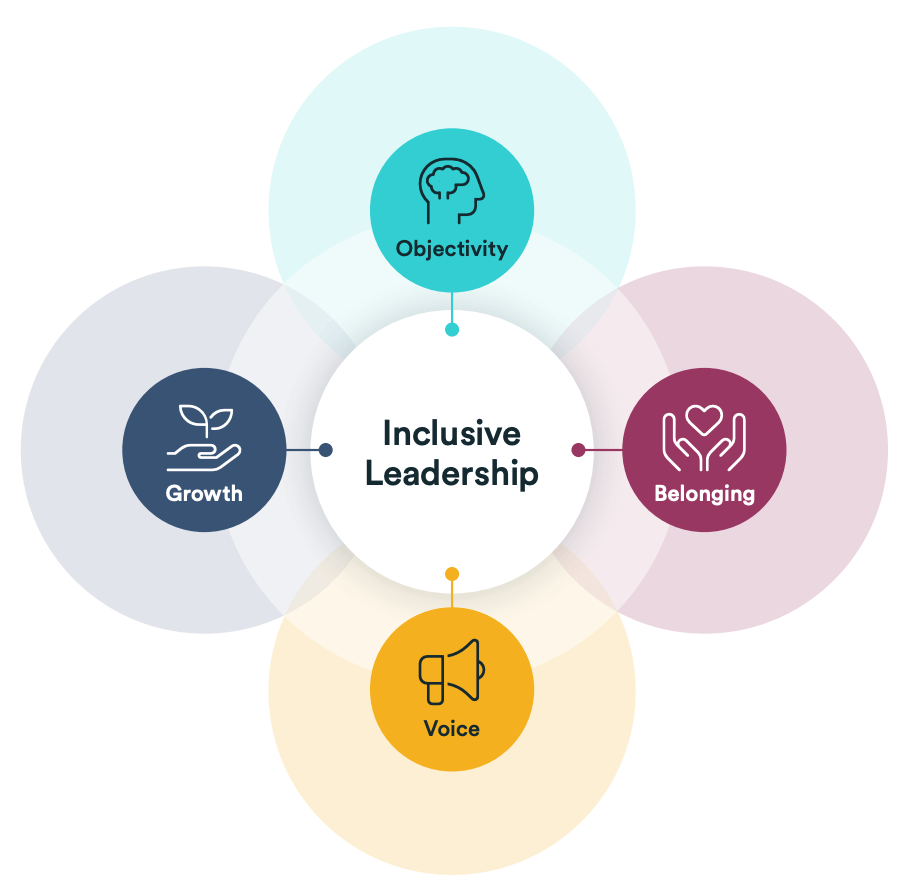
These practices align with our research-backed inclusive leadership behaviours, organised around four pillars:
- Objectivity: Data-driven, consistent decision-making
- Belonging: Ensuring employees feel a strong sense of belonging, respected and valued through genuine inclusivity
- Voice: Creating psychological safety and inclusive dialogue
- Growth: Equitable access to development opportunities
When EDI strategy integrates these pillars into people systems, it moves from aspiration to execution.
What an Effective EDI Strategy Looks Like in Practice
An effective strategy integrates structure, measurement, and governance.
Clear Ownership and Governance (Not Just Committees)
Shared ownership among all stakeholders is valuable. Effective strategies establish clear ownership by defining:
- Who is accountable at board level
- How progress is reviewed
- How leaders are measured
- How risk is escalated
- How decisions are documented
Measurement That Goes Beyond Representation
Representation reflects accumulated outcomes, but it’s a lagging indicator. Leading indicators, which are less visible, are often larger drivers and provide predictive insight over reactive reporting. These include data around:
- Hiring processes
- Performance criteria
- Manager capability
- Learning access
- Policy design
- Inclusion experiences
- Employee relations data
- Demographic disparities across teams
To make culture governable, your leading indicator measurement should include:
- Inclusion survey trends, including insights into lived experiences
- Fairness perceptions
- Psychological safety
- Disparity analysis in ratings and promotions
- Manager training uptake
- Process consistency checks
EDI Embedded Into Core People Systems
Systems sustain culture, which means it’s vital for an effective EDI strategy to align performance criteria with inclusion behaviours, integrate structured decision-making tools, and review demographic patterns quarterly. You should also plan to link leadership incentives to cultural outcomes, ensure learning is reinforced over time, and connect engagement insights with the evolution of your processes.
When you embed EDI into your organisation, it becomes part of how the company operates, not just an additional layer of EDI activities.
Ready for a Different Kind of EDI Strategy?
In the UK’s current environment, organisations face dual pressures of increased scrutiny and heightened employee expectations. But tick-box training and symbolic activity without structure don’t build capability.
When culture change is your goal, your organisation needs a structured EDI strategy that improves retention and:
- Strengthens governance
- Reduces risk
- Expands talent access
- Builds trust
- Improves long-term performance
- Creates resilience in volatile contexts
An effective strategy also positions your organisation to better navigate political shifts, regulatory scrutiny, and workforce change.
If you’re ready to move beyond compliance-first approaches and toward measurable, integrated culture strategy, it may be time to rethink how your EDI strategy is designed. Paradigm partners with UK organisations to connect data, systems, and leadership capability, effectively building cultures where fairness and performance reinforce one another.
To explore what that could look like in your context, connect with a UK-based Paradigm expert.