Our website uses cookies to distinguish you from other users of our website. This helps us to provide you with a good experience when you browse our website and also allows us to
improve our site. By continuing to browse our website, you’re agreeing to our use of cookies. For more information, please read our
Our website uses cookies to distinguish you from other users of our website. This helps us to provide you with a good experience when you browse our website and also allows us to
improve our site. By continuing to browse our website, you’re agreeing to our use of cookies. For more information, please read our


Paradigm
Paradigm’s Culture for Everyone Platform seamlessly integrates AI-enabled software with a team of experts to help companies build high-performance cultures where everyone can do their best work.
In recent years, the spotlight on diversity, equity, and inclusion (DEI)—often referred to in UK organisations as EDI (equality, diversity, and inclusion)—has become sharper than ever.
Post-pandemic, employees expect more of their employers. They want inclusive cultures, not the mere ticking of boxes. At the same time, regulatory obligations remain firm. From the Equality Act 2010 to gender pay gap reporting and transparency requirements, UK firms face both mounting legal pressure and broadening cultural expectations.
For HR leaders in the UK, this means DEI training can no longer be relegated to an annual e-learning module and forgotten. Instead, training is the starting point of a broader culture evolution: not a standalone exercise but the launchpad for long-term change.
To reframe DEI training as a driver of measurable culture change, HR leaders first need to understand what DEI training really means and how it fits into a broader strategy (including why it matters in the UK specifically). They should also be able to identify what it should look like, how to link it to culture change, how to measure its impact, and how to overcome resistance.
Key Takeaways
- DEI training is the foundation for culture change, not a compliance checkbox. In the UK, training should equip people to create psychologically safe, inclusive, high-performing teams.
- Training and strategy must work together. DEI training drives individual behaviour change, while DEI strategy embeds systemic change through policy, governance, and accountability. Aligning both ensures lasting impact.
- Effective DEI training is practical and sustained. Blended learning outperforms one-off sessions, especially in hybrid UK workplaces. The goal is to build skill and behaviour change, not just awareness.
- Measurement and data matter. HR leaders should track both quantitative (survey scores, retention, pay-gap shifts) and qualitative (feedback, focus groups) metrics. AI-powered platforms can help connect training engagement to real culture outcomes.
- Paradigm helps UK organisations scale DEI efforts. Paradigm’s Culture for Everyone model links insight, action, and learning, turning DEI training into a measurable, organisation-wide culture transformation.
What Is DEI Training?
DEI training—short for diversity, equity, and inclusion training—is a structured training programme designed to help individuals and teams build the knowledge, skills, and behaviours needed for a truly inclusive workplace.
At its core, DEI training helps participants understand three key pillars:
- Diversity: Recognising and valuing differences across race, gender, age, sexual orientation, disability, socioeconomic background, learning style, and beyond
- Equity: Ensuring fairness in processes, opportunities, and resource allocation so that all individuals, including those who face systemic barriers, can reach equal outcomes
- Inclusion: Creating a working environment in which everyone feels respected, valued, connected, and able to contribute and thrive
In the UK, DEI (or EDI) training is often grounded in organisational culture change and regulatory imperative. It goes beyond a mere awareness of diversity to embedding inclusive behaviour and linking learning to measurable outcomes.
Ultimately, effective DEI training is not just a one-off “tick-box” session. It reflects the lived experience of diverse employees and is tied into business systems, policies, and culture so that inclusive practices become part of everyday working.
The aim is to enable people at all levels to contribute to an environment where everyone can bring their full selves, be heard, contribute, and thrive—not just fit in.
Core DEI Training Topics
Reliable DEI training topics include areas like:
- Unconscious bias (also called implicit bias): Understanding how mental shortcuts influence decisions
- Microaggressions: Recognising subtle, often unintentional behaviours or comments that can undermine inclusion
- Allyship: Equipping people who are not from underrepresented groups to act as advocates and contributors
- Inclusive leadership: Ensuring people managers and senior leaders have the capability to lead inclusive teams and embed inclusive practices
- Psychological safety: Creating conditions where people feel safe to speak up, bring risks, ask for help, make mistakes, and innovate
- Intersectionality: Recognising that individuals hold multiple identities that overlap and interact (for example, gender + race + disability) and consequently may face combined demographic barriers
Regardless of exact topics, training should be practical, evidence-based, and measurable, not just conceptual.
DEI Training vs. DEI Strategy: What’s the Difference?
Training and strategy differ in the DEI/EDI context. While they are related, they serve different but complementary purposes:
- DEI training is about individuals and small-group capability: equipping people to change their behaviours, recognise and act on inclusion challenges, and lead inclusive teams.
- DEI strategy is about systemic, organisational, and structural change: the policies, practices, data, leadership governance, culture, systems, and accountability mechanisms that embed inclusion and equity across the organisation.
In this framing, training is one component of a broader inclusion strategy. It helps operationalise it. Without strategy, training risks being a “nice to have” but not sustainable. Without training, strategy can remain aspirational but unrealised.
One of the strengths of Paradigm is that its model aligns both. Its Culture for Everyone platform connects training with strategic insight, data analytics, and actionable change plans. For UK HR leaders, this means choosing a partner or solution that delivers both the workshops and the sustained change.
Why DEI Training Matters in the UK
While DEI training plays an important role everywhere, it’s an especially critical focus in the UK right now. Here are a few reasons why.
Regulatory and Societal Context
In the UK, organisations must contend with a mix of legal, social, and business imperatives:
- Equality Act 2010 sets out protected characteristics and mandates that organisations ensure non-discrimination, equality of opportunity, and fairness.
- Gender pay gap reporting (for larger employers) puts a spotlight on pay and progression differentials by gender and creates scrutiny from regulators, investors, and employees.
- The Modern Slavery Act 2015 transparency obligations, while not strictly DEI training mandates, contribute to the broader expectation of ethical and inclusive practice across supply chains.
- Employee expectations have changed: Post-pandemic, many people value working for organisations where inclusion is real—not just branded.
Evidence of Continuing Barriers
Despite progress, there are still persistent inclusion gaps in UK workplaces. For example:
- According to the Chartered Management Institute (CMI), more than half of employees in UK organisations say they’ve been overlooked for opportunities because of their identity; 41% have witnessed colleagues negatively affected because of their background.
- The Chartered Institute of Personnel and Development (CIPD) found that 54% of white British respondents said their career progression met expectations, compared to only 49% of ethnic-minority respondents.
- A report by Deloitte found that in the UK, 40% of respondents with disabilities, chronic health conditions, or neurodivergence experienced micro-aggressions, harassment, or bullying in 2024.
These gaps highlight that inclusion is not simply about numbers but about experience, belonging, voice, and progression.
Business and Talent Imperative
The business case for DEI programmes is also strong. According to a report by McKinsey & Company, having women’s representation on executive teams in 2023 made companies 39% more likely to outperform their annual financial goals than their bottom-quartile peers. This number more than doubled between 2015 and 2023, rising from an initial 15% likelihood.
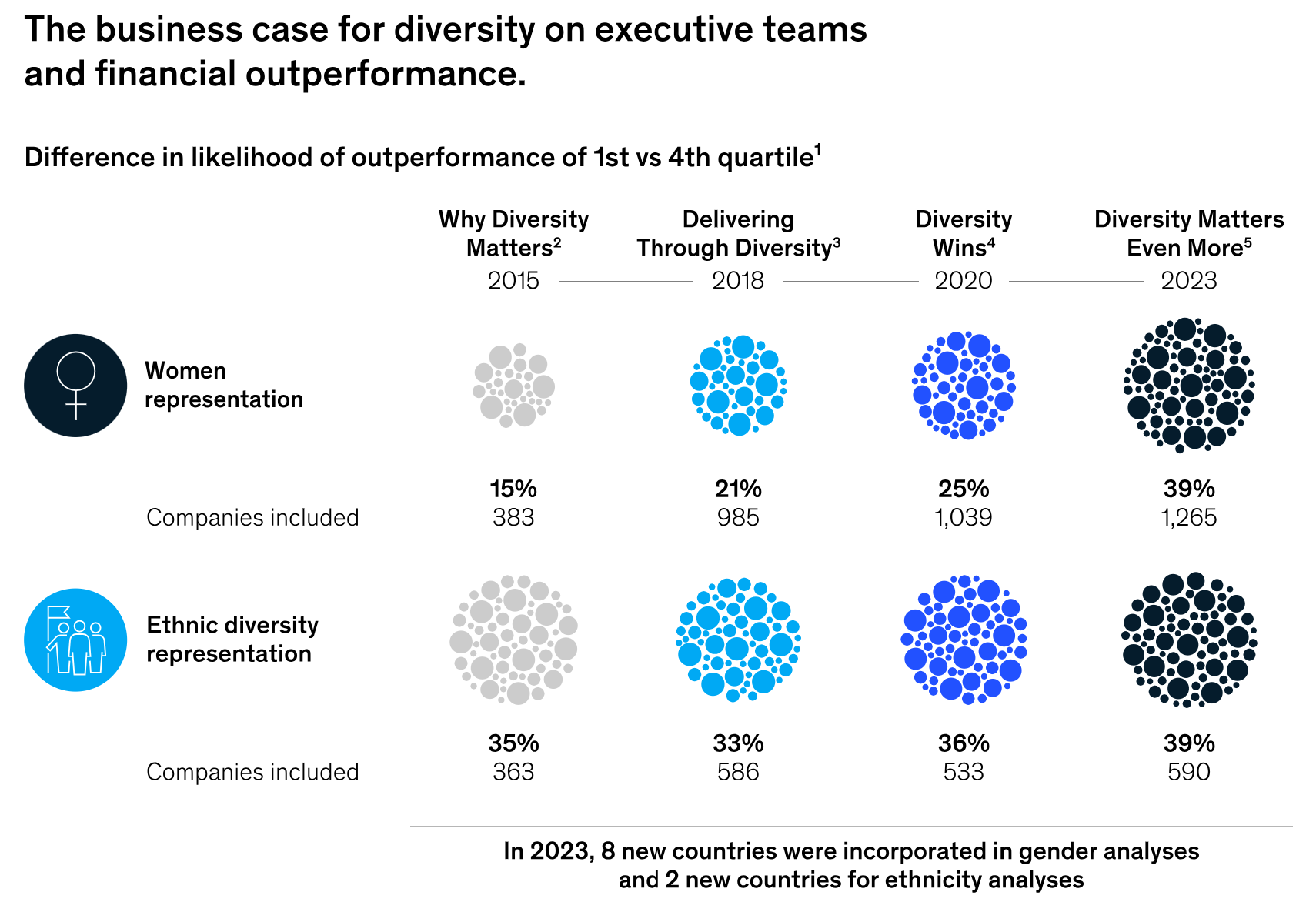
The same is true for ethnic diversity on executive teams, which also increased the likelihood of financial outperformance by 39%. This indicates that a lack of diversity may actually be getting more expensive.
Organisations that miss out on building inclusive cultures may face retention risks, talent-pipeline gaps, reduced innovation, reputational risk, and regulatory exposure.
What Does DEI Training Include?
For UK HR leaders planning or reviewing DEI training, here is a practical checklist of what to include.
Content
When putting together the training courses, you can create professional development modules that stick with learners by covering the following:
- Foundational modules: Unpack core topics like unconscious bias, understanding microaggressions, and creating a safe work environment.
- Role-specific modules: Create targeted courses by role on topics like inclusive hiring for HR professionals, leading diverse teams and inclusive leadership development for managers and executives, and allyship for colleagues.
- Advanced or contextual modules: Cover more nuanced conversations like remote/hybrid inclusion (critical for UK workplaces with hybrid teams), cultural competence, intersectionality, disability inclusion, ageism, sexual orientation and gender identity inclusion, and neurodiversity inclusion.
- Reflection and application: Use scenario-based exercises, case studies, discussion groups, and action-planning to bring topics to life.
- Resources and tools: Supply checklists, strategy guides, workbooks, and job-specific workflows where inclusive behaviours are supported. Paradigm users can download pre-developed checklists and other resources.
Delivery Formats
Everyone learns differently. Training in modern UK organisations should embrace multiple modalities, such as:
- Online/self-paced learning: Provide scalable, flexible options that allow learners to complete modules at convenient times and revisit content.
- Live, facilitator-led, in-person workshops or virtual sessions: Allow for real-time discussion, shared experiences, scenario practice, and deeper employee engagement.
- Blended programmes: Combine self-paced content with live workshops or webinars and follow-up activities for a blended learning approach.
- Micro-learning and reinforcement modules: Offer short videos, reminders, prompts, applied tasks, and workbooks to sustain learning over time rather than assigning a one-off module.
- Tailored cohorts/audience-specific training: Provide different content for different job titles, such as senior leaders, mid-managers, frontline employees, and HR/business partners, or for different geographies or business units.
Structure and Cadence
Avoid a single “tick-box” session. Effective DEI training is sustained and embedded into the learning ecosystem. For example, you could include:
- Pre-work/a self-paced module introducing concepts
- Live workshops to discuss, apply, and plan how to embed the concepts
- Follow-up tasks or micro-modules to embed learning into roles
- Reinforcement over time through refresher sessions, action checkpoints, and/or communities of practice
- Integration into existing people processes, such as onboarding, performance reviews, leadership development, and team development
With hybrid working, multi-site operations, global HQs, and regulatory demands rampant in the UK, scalable online plus regionally facilitated workshops make sense, and accessibility must be considered. This might mean using captioning, localisation, or inclusive language features.
The good news: Paradigm’s Reach learning management system (LMS), virtual/in-person workshops, and reflection and skill practice resources provide a sustained, accessible and scalable training approach with blended modalities.
Linking Training to Long-Term Culture Change
It’s one thing to deliver training. It’s another to embed the learning into systems, behaviours, and culture so that it drives change and becomes part of your organisational fabric. Here are a few DEI tips for how you can combine the two to create lasting change.
Embedding Across Formats and Realities
Because many UK teams are hybrid or remote, learning experiences must be adapted to each specific workplace. For example, inclusive behaviours differ when teams meet mostly online, so training must address those realities. This is especially true within organisations that span multiple regional sites and have global operations.
In the same realm, ensuring accessibility is built in is also key. E-learning should include captions and diverse case studies, be easily translatable, and be mindful of regional, UK-specific context. For example, the modules should understand UK equality legislation, the UK’s culture of inclusion, and language nuances. The same is true if your company also operates offices in the U.S. or Australia.
Systems and Governance Linkage
Training must be married to governance, policy, and process to ensure sustainability and accountability. For example:
- Leadership accountability in appraisal frameworks and KPI’s: Assess and reward inclusive leadership behaviours.
- Employee resource groups (ERGs) and inclusion councils: Feed training attendees into communities of practice and change networks.
- HR and people processes: Reference inclusive practices in hiring, promotion, performance review, pay gap analysis, succession planning, and onboarding.
- Data-driven insight: Link training results to culture surveys, HRIS data, and inclusion indices to refine strategy.
Realising Culture Change Over Time
Culture change is not instantaneous. Training sets the capability, strategy and systems embed the behaviour, and leadership drives accountability. For UK HR leaders, the key is to position training as the start of a journey—one that is integrated with your broader DEI strategy rather than a standalone event.
When training is aligned with structural supports, reinforced by leadership, and measured, the potential for transformation is real. You create an inclusive culture where people feel a sense of belonging, where decision-making is inclusive, and where teams innovate.
The Paradigm Model: Get Insight → Take Action → Enable People
Paradigm’s Culture for Everyone model provides a structured framework for embedding this connection:
- Get Insight: Through its Inclusion Survey and AI-driven data integration, Paradigm helps organisations identify where their inclusion challenges lie—linking perception data from employees with HRIS and engagement metrics to pinpoint opportunity areas.
- Take Action: Using these insights, Paradigm’s Blueprint provides prioritised recommendations for where to focus next, whether that’s on inclusive leadership, equitable progression, or psychological safety.
- Enable People: The Reach learning platform and catalogue of workshops deliver tailored, sustained DEI training that empowers individuals to drive the change identified by the data.
This closed-loop model ensures that training is informed by evidence, tied to measurable outcomes, and continually adapted based on impact.
A key differentiator of Paradigm’s approach is its AI-powered analytics, which connect learning data, HRIS insights, and employee survey trends to reveal how training influences broader culture metrics.
For example, organisations can see which modules most strongly correlate with improvements in inclusion, belonging, or retention scores. This data-led approach transforms DEI training from a “soft” initiative into a strategic lever—one that not only drives equity and inclusion but also provides hard evidence of progress to leadership teams, boards, and external stakeholders.
Measuring Impact and Overcoming Resistance
Diversity training only matters if you can demonstrate that it works. Here are a few ways you can measure and demonstrate the ROI of your DEI training.
How To Measure the Impact of DEI Training
Key metrics and practices UK HR leaders should consider monitoring include:
- Pre-training baseline surveys: Measure awareness, motivation, and enablement prior to any training activities as a benchmark for where your organisation started.
- Post-training surveys: Capture change in understanding, confidence, commitment, and planned behaviours after training activities to note any significant shifts.
- Behaviour-change indicators: Track actual changes in hiring, promotion, turnover, employee voice surveys, psychological safety scores, and inclusion/belonging surveys.
- Retention/turnover data: Monitor whether underrepresented groups are staying and if managers trained in inclusion are retaining more diverse teams or seeing improved engagement.
- Inclusion/belonging metrics: Measure the percentage of employees who say they can be their authentic selves, feel they belong, have a voice, or feel they are heard at work.
- Qualitative feedback: Conduct focus groups and gather narrative stories and open-ended feedback from participants and leaders.
- Linkage to compliance metrics: Track any changes related to your gender pay gap, ethnicity pay gap (where disclosures apply), diversity of pipelines, promotion rates, and other compliance-related metrics.
Using Data and AI to Demonstrate ROI
Many UK organisations struggle with demonstrating ROI for DEI/training initiatives, partly because measurement is inconsistent and data silos persist. Here’s how sophisticated measurement works.
A platform such as Paradigm’s uses AI-powered analysis to connect training engagement data with HRIS and survey data, enabling insights into which training modules correlate most with improved culture and inclusion metrics. Rather than simply tracking “attendance = done,” such platforms track engagement, completion, return to behaviours, effect on team metrics, and culture indices.
This data enables the HR leader and executive team to articulate a narrative: “Here’s the investment in training, here’s the change in inclusion scores, here’s the impact on retention/engagement/performance, and here’s how we are embedding this into our strategy.”
For UK boards and senior leadership who may push for tangible ROI and a link to ESG/people capital metrics, this kind of measurable insight is increasingly important.
Overcoming Resistance and Tick-Box Fatigue
Many UK HR leaders will recognise the scepticism and fatigue around DEI/EDI training. Some people see it as performative, irrelevant, or disconnected from their day-to-day role. Here are strategies to navigate this resistance:
- Start with leadership buy-in: Senior leaders must visibly participate in and support the training and link it to business performance and cultural ambition.
- Communicate the “why”: Emphasise the business case (retention, innovation, brand, regulatory risk) as well as the moral case. In the UK, connect training to compliance obligations, workforce voice, and talent pipeline challenges.
- Customise the experience: Avoid generic, off-the-shelf modules that feel irrelevant or patronising. Tailor content to your industry and target different audiences.
- Enable managers: Give managers practical tools to have inclusive conversations, lead inclusive teams, embed training in team meetings, and monitor inclusive behaviours.
- Follow-through and accountability: Training without follow-up will drop off. Use action planning, refreshers, manager check-ins, and inclusion metric reviews.
- Frame training as the start, not the output: Make it clear that training is one part of the journey. The culture you build after the training matters most. When employees see that the training is backed by systems, leadership action, and policy change, they are more likely to engage authentically.
- Address perceptions of tokenism: Demonstrate how training links to real-world changes (for example, inclusive hiring practices, transparent progression, employee resource group actions, etc.). Link training to tangible change, not just awareness.
Paradigm Helps UK Organisations Scale DEI Training That Lasts
In the UK today, DEI training is more than a compliance chore: it’s a strategic enabler of culture, performance, and reputation. For HR leaders who want to embed DEI training into their broader strategy and deliver sustainable culture change, Paradigm presents a compelling option:
- It’s scalable: For multinational UK organisations or those with hybrid/remote teams, the blended approach works across geographies and modalities.
- It’s accessible: The model supports varied learning needs (micro-learning, self-paced, live facilitated), which is important in UK workplaces with dispersed teams and different time zones.
- It’s data-led: With growing demand in the UK for evidence-based DEI work, the AI-enabled insight and measurement differentiator means HR leaders can report outcomes to senior leadership and boards.
- It’s strategically integrated: The training is not isolated—it’s linked to organisational priorities and measurement.
- It’s customisable: Paradigm can be tailored to different audiences and contexts, avoiding the “one-size-fits-all” trap that so many UK organisations fall into.
If you’re an HR leader in the UK looking to create sustained behaviour change, explore a free demonstration of Paradigm’s platform. Look at how the training links to your strategic priorities, how measurement is built in, and how governance and systems connect.
FAQs About DEI Training for UK Organisations
What is DEI training in the UK?
DEI training (often referred to as EDI—equality, diversity, and inclusion—training in the UK) is a structured learning approach designed to help employees and leaders build the knowledge, skills, and behaviours needed to create inclusive, equitable workplaces. It typically covers topics such as unconscious bias, allyship, microaggressions, and inclusive leadership, all within the context of UK legislation and workplace culture.
The goal is to create lasting behaviour change, enabling people to foster psychological safety and well-being, reduce bias in decision-making, and contribute to fairer, more innovative teams.
What’s the difference between DEI and EDI?
In practice, DEI (diversity, equity, and inclusion) and EDI (equality, diversity, and inclusion) describe the same organisational goals, though the terminology varies by region. In the UK, “equality” reflects alignment with the Equality Act 2010 and the country’s long-standing focus on equal opportunities, while “equity” (more commonly used in the U.S.) highlights fairness and the removal of systemic barriers.
Many UK organisations use the terms interchangeably, but the essence remains the same—ensuring fair treatment, representation, and belonging for all employees.
Is DEI training mandatory under the Equality Act 2010?
The Equality Act 2010 does not explicitly require DEI training, but it does obligate employers to prevent discrimination, harassment, and victimisation in the workplace. Regular, well-designed DEIB training helps organisations meet these duties by demonstrating a proactive commitment to compliance and inclusion.
For many UK employers, training also serves as an important defence in legal claims, showing that the organisation has taken reasonable steps to educate its diverse workforce, promote inclusive behaviour, and prevent unlawful discrimination.
How can organisations measure DEI training impact?
UK organisations can measure the impact of DEI training by combining quantitative and qualitative methods. This may include pre- and post-training surveys, changes in inclusion or belonging scores, feedback from participants, and shifts in key HR metrics such as retention, progression, or representation across diverse groups.
Linking results to broader compliance reporting—such as gender or ethnicity pay gap data—helps show tangible progress. Increasingly, forward-thinking employers use AI-enabled tools (like Paradigm’s Culture for Everyone platform) to connect training engagement data with HRIS and employee survey results, revealing which DEI initiatives drive the greatest cultural and performance impact.