Our website uses cookies to distinguish you from other users of our website. This helps us to provide you with a good experience when you browse our website and also allows us to
improve our site. By continuing to browse our website, you’re agreeing to our use of cookies. For more information, please read our
Our website uses cookies to distinguish you from other users of our website. This helps us to provide you with a good experience when you browse our website and also allows us to
improve our site. By continuing to browse our website, you’re agreeing to our use of cookies. For more information, please read our

Joelle Emerson
Before founding Paradigm, Joelle was a civil rights lawyer. Joelle’s legal background highlighted the consequences that can result from companies failing to consider culture early, and inspired her to found Paradigm.
A purpose-built intelligence layer that helps talent leaders understand culture, benchmark what works, and turn insight into action.
Since starting Paradigm over a decade ago, I’ve spent most of my time in rooms with talent and culture leaders trying to answer the same deceptively simple questions: How do you build cultures where everyone can do their best work? Why do some teams thrive while others stall? Where are companies losing their best people, and why? Which investments in culture actually move the needle, and which ones sound good but actually backfire?
The answers have always been there: scattered across HRIS systems, engagement surveys, performance data, policies, leadership behaviors, and institutional knowledge that rarely lives in any single system. What’s been missing is a way to bring it all together.
Today I’m excited to launch Surface, a platform that gives talent leaders something they’ve never had before: a unified view of everything shaping their organization, benchmarked against peers, built with Paradigm’s deep expertise, and designed to turn insights into action. With Surface, what used to take months of work can now be done in minutes.
What Surface Does
Surface is an AI-native talent and culture intelligence platform purpose-built for the modern talent leader. It does three things that no other platform does today.
First, it creates a unified intelligence layer from fragmented data.
Your HRIS, your engagement platform, your performance management tool, your employee relations system, your company policy documents…each captures one slice of the picture. Surface sits on top of all of them, bringing together key data and context, and layering in institutional knowledge gathered through a detailed inventory of your talent practices — the stuff that shapes culture but rarely lives in any system. Instead of spending weeks stitching together information from a dozen systems to answer a basic question, leaders get an immediate, complete picture.
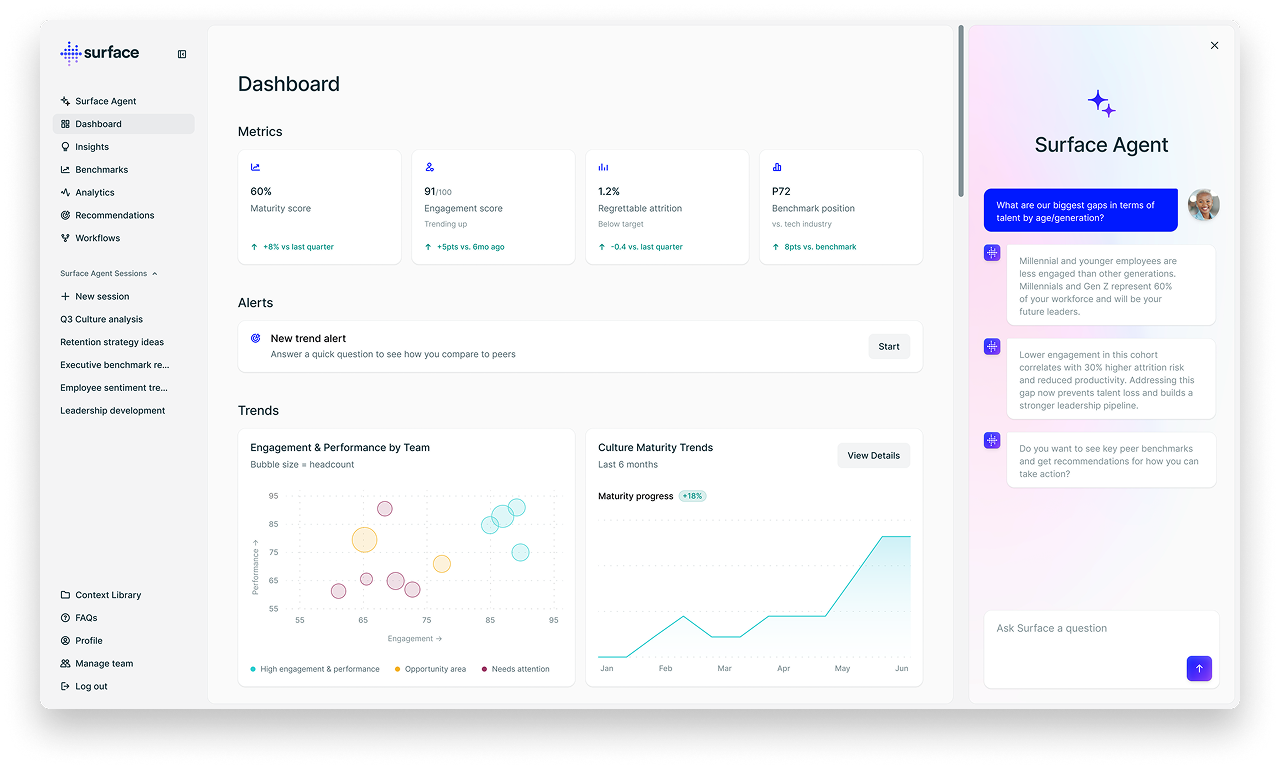
Second, it benchmarks you against peers on the things you’ve never been able to benchmark. Most companies can benchmark compensation. What our clients have repeatedly told us over the years is that they can’t benchmark the talent and culture practices that actually drive outcomes: how you run performance reviews, what your parental leave looks like in practice, how you develop managers how your onboarding compares. Surface can. It’s powered by proprietary benchmarks built from more than a decade of work with companies of all sizes, across sectors. You can see exactly how your approach compares and where the gaps are.
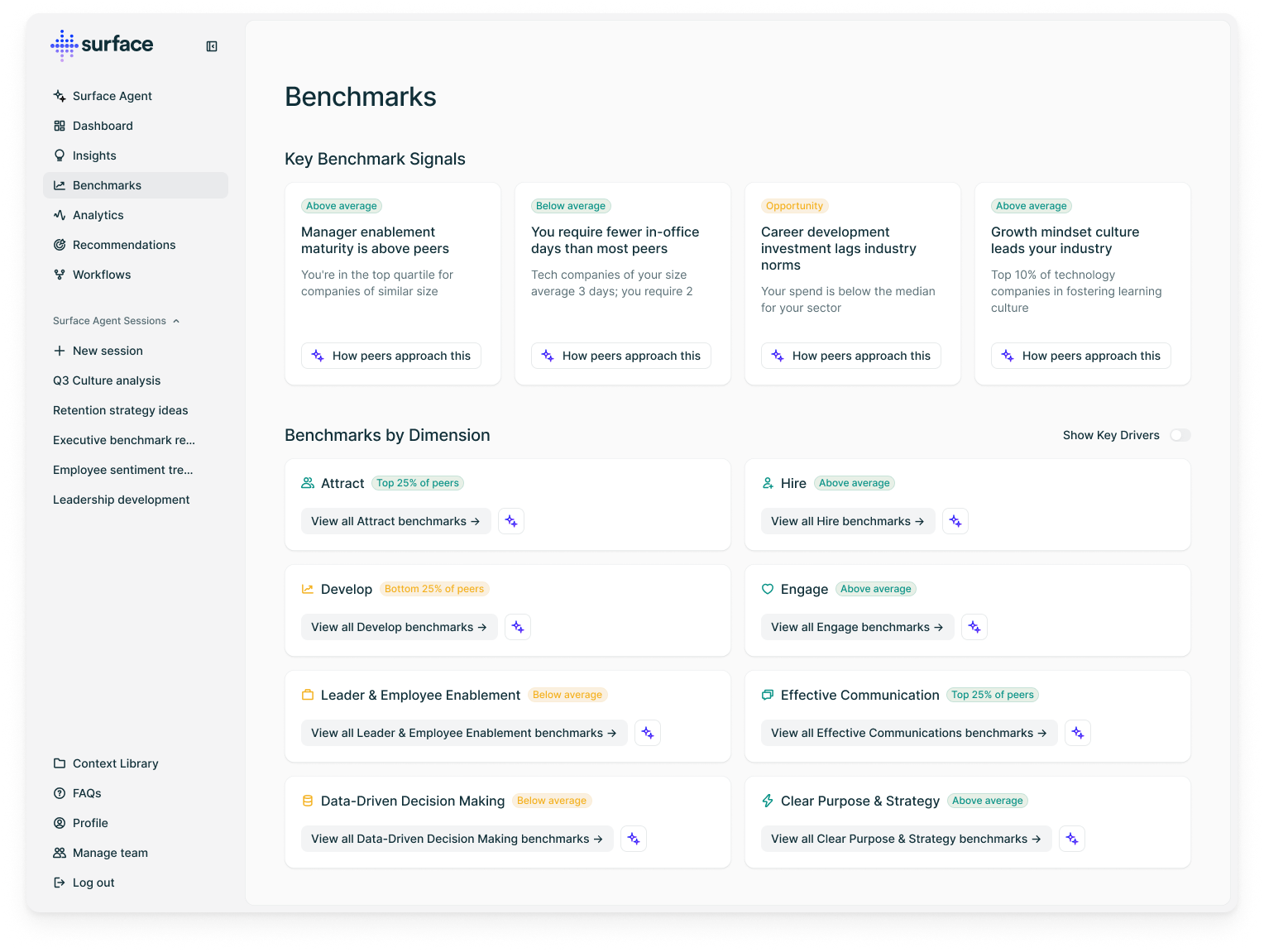
Third, it doesn’t just answer questions. It does the work like an expert would. This is where the Surface Agent comes in.
The Surface Agent
Most AI tools for HR offer chatbot-style Q&A. The Surface Agent is different. Think of it as the expertise our team at Paradigm has built over twelve years, available on demand as your executive advisor, people analyst, and execution partner.
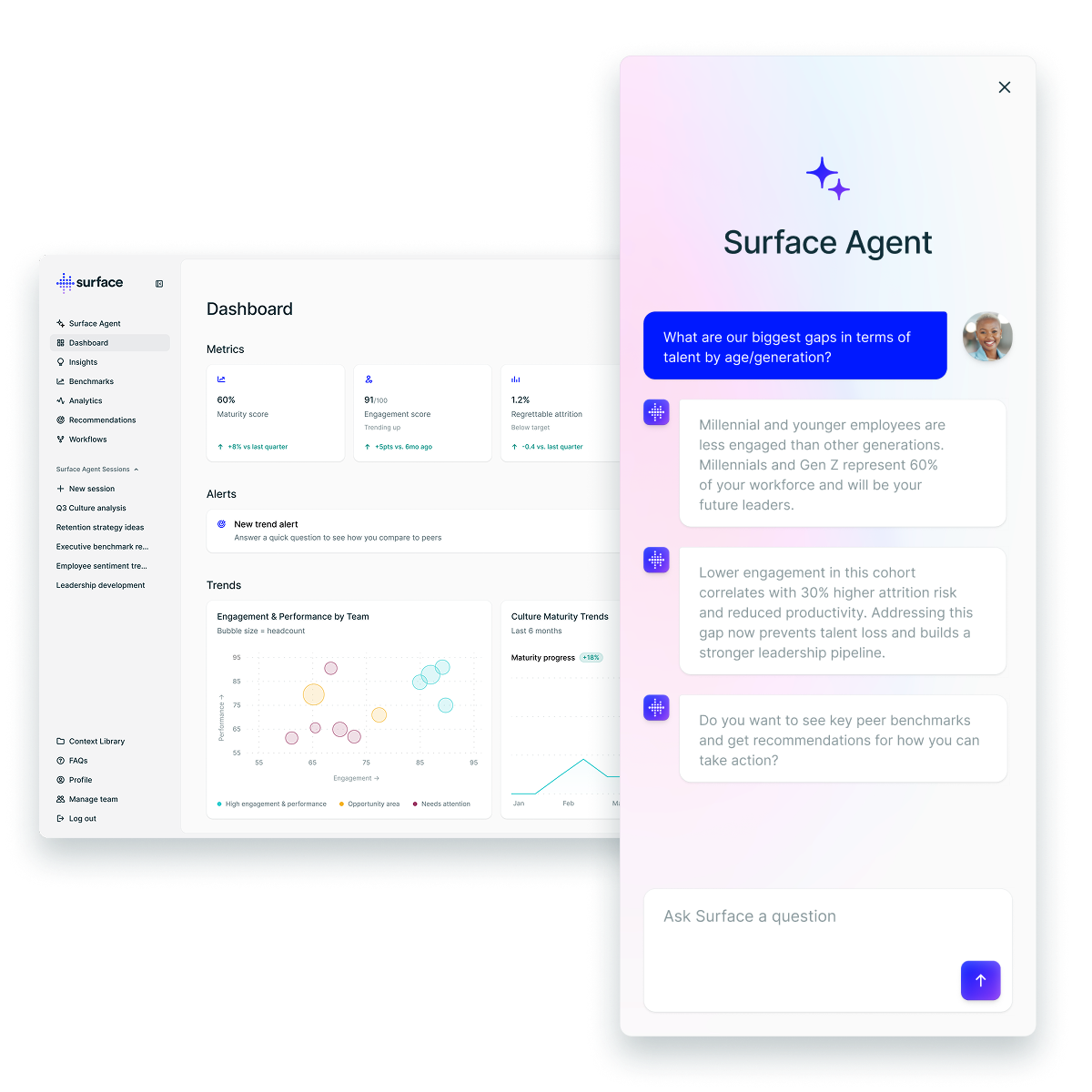
Two examples of what that looks like in practice:
The board deck. Every talent leader I know dreads the quarterly board report. It takes weeks: pulling data from multiple systems, building narratives that connect people metrics to business outcomes, and formatting slides. With Surface, you can describe what the board needs to see and the Agent produces a first draft complete with the right data, benchmarked comparisons, and a narrative that connects your talent strategy to business results. This isn’t a generic template. It’s a draft built from your actual data and organizational context. What I used to spend two weeks helping my clients write is now ready for review in minutes.
The engagement question. Over the last 12 years, hundreds of companies have come to us after an engagement survey to ask some version of “We’ve gotten our results. Now what?” Historically, answering that question often required weeks or months of consulting work to determine whether those signals actually mattered and, if they did, what to do about it.
Ask a general-purpose AI tool that question and you’ll get a decent five-step framework you could find in any management textbook. Ask Surface, and it looks at your actual engagement data, identifies the specific drivers underperforming relative to your peers, cross-references those with your current HR data, programs and policies, and produces a targeted, prioritized action plan. What used to take months of consulting now happens in the background as you catch up on email.
It’s the difference between a tool that makes you feel productive and one that actually changes how your team operates. The best talent leaders we work with know exactly how they should be spending their time: shaping strategy, advising their CEO, connecting culture to business outcomes. Most of them will tell you they spend less than 20% of their time on those things. Surface changes that ratio.
Why It Had to Be Us
When I founded Paradigm, we started with a specific focus: using data and evidence-based practices to help companies build stronger, more inclusive workplaces. We believed then, and we know now, that building cultures where everyone can do their best work is one of the most reliable ways to unlock company performance. Cultures that attract people from all backgrounds, where people who are different from one another can collaborate and communicate effectively, and where the right people are recognized and rewarded, consistently perform better.
Over the years, working with hundreds of organizations, we kept seeing the same pattern. The companies that were best at building high-performance, inclusive cultures weren’t treating culture as a standalone initiative. They were treating it as an integrated system. One where onboarding, performance management, manager effectiveness, career development, learning, and dozens of other practices all reinforced each other.
The companies that struggled were usually trying to fix individual pieces in isolation: updating a parental leave policy and hoping women would stay longer, redesigning a performance management process and assuming performance outcomes would improve. Failing to see how the whole system worked together.
For the last decade, this is exactly what we did. We would go into organizations and spend six months pulling every data source we could get our hands on — HRIS and ATS data, survey results, performance reviews, focus groups, exit interviews, policies, benefits — interviewing people to discover the unwritten context, and then analyzing all of those inputs to surface the specific talent and culture practices that lead to business outcomes. We would then build a roadmap of what to change and why. It was transformative work. But it was also slow, expensive, hard to iterate, and hard to scale.
With AI, things have changed. For the first time, it’s possible to analyze the full system of signals that shape culture at once — across structured data, unstructured feedback, policies, and organizational practices — and surface patterns that previously required months of consulting work and hundreds of thousands of dollars to uncover.
That realization led us to build Surface.
Where Existing Solutions Fall Short
Leaders across the profession are experimenting with AI tools, and they should. But talent and culture work is fundamentally different from other functions. In many domains, the cost of an AI getting something slightly wrong is inefficiency. In talent and culture work, the cost of getting it wrong is trust. A poorly designed policy, a misread attrition trend, or a slightly insensitive communication don’t just waste time. They undermine the credibility that talent leaders depend on to do their jobs.
General-purpose AI models don’t know your organization. And most HR-specific tools tend to do one of two things well. Some capture and analyze multiple signals but stop at insight, leaving you to figure out what to do next. Others drive action but only on a single workflow or data source. What talent leaders actually need is both: the full picture and the ability to act on it.
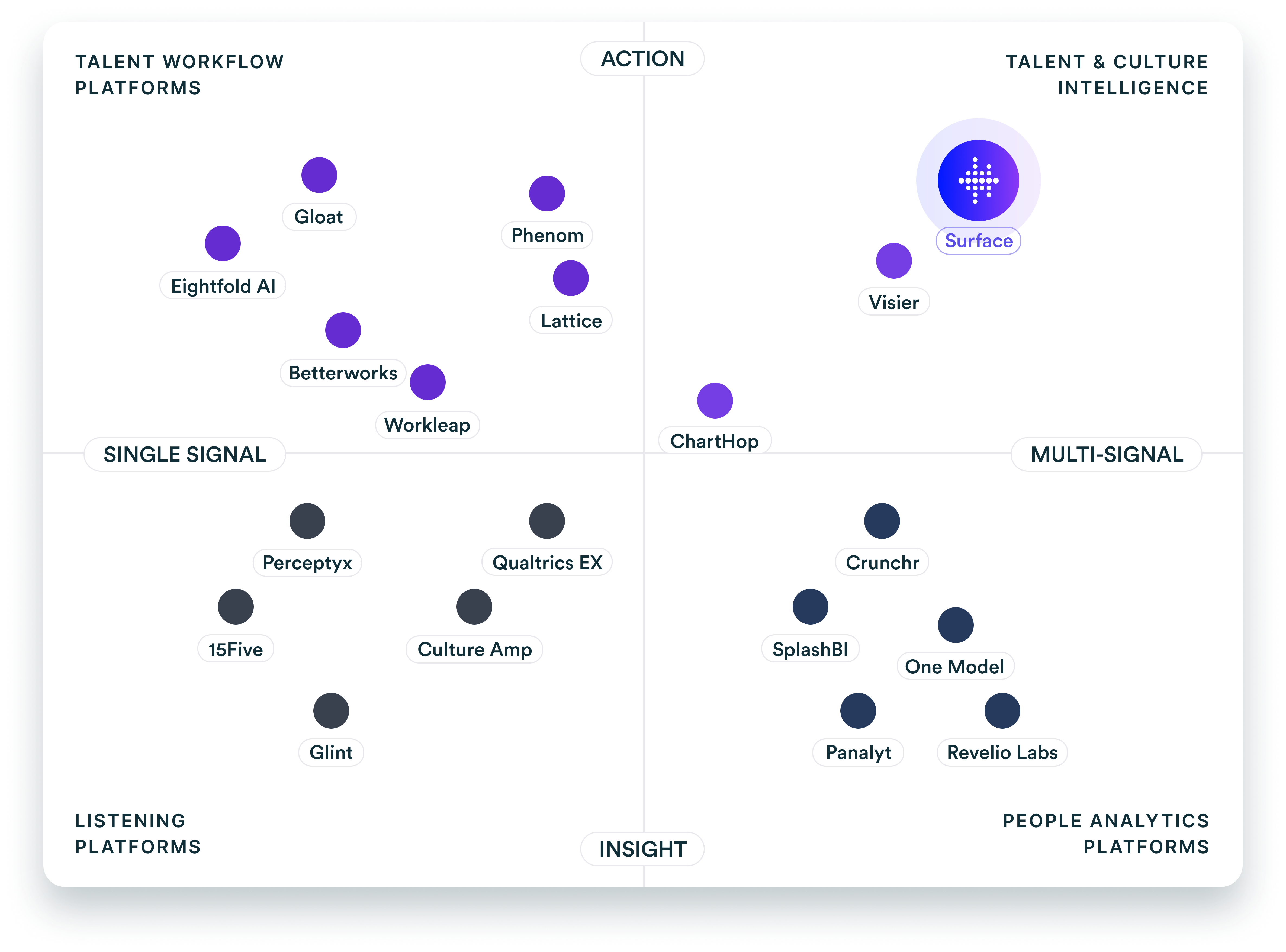
That’s what Surface was built to do.
The Next Era of Talent Leadership
For years, talent leaders have been responsible for one of the most important systems in any organization — the system that shapes how well the organization actually performs — and asked to run it without the infrastructure the work deserves. That era is ending.
After over a decade of seeing, up close, how culture actually drives performance, we built Surface to make that connection visible and actionable for every talent leader. It’s built on real data, real expertise, and a deep belief that culture isn’t a soft topic. It’s the operating system of every organization. And the leaders who run it deserve tools that treat it that way.
Surface is available now.
Sign up for your Surface demo today at surface.ai