Our website uses cookies to distinguish you from other users of our website. This helps us to provide you with a good experience when you browse our website and also allows us to
improve our site. By continuing to browse our website, you’re agreeing to our use of cookies. For more information, please read our
Our website uses cookies to distinguish you from other users of our website. This helps us to provide you with a good experience when you browse our website and also allows us to
improve our site. By continuing to browse our website, you’re agreeing to our use of cookies. For more information, please read our


Paradigm
Paradigm’s Culture for Everyone Platform seamlessly integrates AI-enabled software with a team of experts to help companies build high-performance cultures where everyone can do their best work.
If you’re an HR leader, you’ve probably run your fair share of employee engagement surveys—collecting responses, analyzing data, and sharing scores with leadership. Yet often, the results feel flat. The numbers confirm what you already suspected, and there doesn’t seem to be much follow-up.
The problem isn’t surveys themselves. It’s how they’re used. Many organizations stop at sentiment scores, treating them as annual check-ins rather than strategic tools for culture transformation. Without linking insights to meaningful actions, surveys fail to influence decisions or drive real change.
Engagement surveys become truly powerful when embedded in inclusive culture systems and paired with clear action and accountability. Learning how to design, analyze, and act on employee engagement surveys can help you translate data into measurable improvements in performance, belonging, and retention.
The Limits of Traditional Employee Engagement Surveys
Engagement surveys aren’t inherently flawed—they’re underleveraged. Without alignment to culture, leadership accountability, and organizational systems, even the best survey becomes data that gathers dust.
Traditional engagement surveys fall short for predictable reasons:
- They focus on scores, not drivers. Organizations obsess over whether engagement is 72% or 76% but don’t dig into why employees feel a certain way or which systems need to change.
- Long lead times create stale insights. Annual surveys often deliver feedback months after it was collected, causing employees to feel like their voice doesn’t matter since nothing is changing.
- Aggregated results hide disparities. Averaging responses masks critical differences. Gallup’s 2024 State of the Global Workplace report found that only 23% of employees worldwide say they’re engaged, yet it also pointed out that workplace engagement levels vary widely across demographics. Without disaggregation, you can’t see or address these inequities.
- There’s no accountability or follow-up. Employees complete surveys, then either hear nothing or receive only vague commitments with no clear owners, timelines, or goals. This teaches them that feedback is performative.
Even well-designed surveys can’t drive change unless their insights inform the systems and decisions that shape employee experience.
How To Design Surveys That Drive Actionable Insights
Getting the most out of your employee surveys isn’t just about asking the right questions—it’s about setting up your systems to change. The real measure of success is whether your data drives decisions that improve belonging, performance, and retention.
Follow these steps to design outcome-driven surveys that get results:
- Link every question to a decision point. Don’t ask questions just to gather sentiment. If you ask about promotion fairness, be ready to examine and revise evaluation rubrics and promotion criteria. If you can’t connect a question to concrete action, don’t include it.
- Balance quantitative and qualitative data. Likert scales provide trendable metrics, but open-text responses reveal the “why” behind them. Pair conceptual ideas like “My voice is valued at work” with open-ended prompts inviting employees to share a recent example.
- Design for disaggregation. Structure your survey to allow analysis across demographics, departments, and tenure. Research from SHRM shows that disaggregated data analysis reveals engagement disparities that averaged data conceals, especially among underrepresented groups.
- Prioritize psychological safety. Communicate why feedback matters, how it’s going to be used, the confidentiality protections in place, and when employees can expect to see change. Transparency builds trust and improves participation.
With these principles in mind, here are some sample survey questions you can use for inspiration:
- “Do leaders at your company believe that people can learn new things but can’t change their core talents and abilities?”
- “Does working here motivate you to exceed what you would do in a similar role elsewhere?”
- “Can you easily access the resources and information you need to perform your job effectively?”
- “Does this company provide equal opportunities to succeed for people from all backgrounds?”
Connect Survey Data to Organizational Systems
Survey responses are signals about how your organizational systems are functioning. The most valuable insights come from connecting engagement data to the rest of your people metrics.
Here are some best practices for analyzing your survey data:
- Link survey results with data on turnover, promotions, retention, and mobility. If overall engagement is high but turnover is spiking in a certain department, you’ve uncovered a disconnect. If underrepresented employees report lower belonging and are promoted at lower rates, that points to systemic inequity—not isolated dissatisfaction.
- Distinguish between leading and lagging indicators. Belonging, psychological safety, and engagement are leading indicators that predict future outcomes. Turnover and performance issues are lagging indicators that reflect what’s already happened.
- Pay attention to who isn’t responding. Low response rates from specific teams or demographics signal trust gaps. Non-response is data too, often the most important type you have.
- Use narrative alongside numbers. Open-text responses highlight behaviors, barriers, and cultural patterns that scores alone can’t capture.
- Benchmark internally and externally. Track progress year over year, then use industry benchmarks to understand context. Your goal isn’t to match external averages. It’s to improve the systems shaping your company culture.
Surveys have impact when they’re tied to culture drivers: leadership behaviors, fairness in promotions, equitable access to development opportunities, and inclusive team norms.
How To Turn Survey Findings into Change
Once you’ve analyzed your survey responses, it’s time to take action. But to turn findings into change, you need a strategic approach.
Prioritize findings by impact over feasibility, focusing on changes that will drive meaningful improvement with available resources. Create actionable plans with clear owners, measurable goals, and timelines. For example: “VP of Engineering will implement structured interview training for all onboarding managers by Q2, aiming to improve belonging scores among underrepresented engineers by 15% in next year’s survey.”
Embed accountability in leadership reviews and team goals. Include survey-driven workplace culture metrics in performance reviews and OKRs, and make improving belonging as important as hitting revenue targets.
Close the loop by communicating actions. Tell employees what you heard, what you’re doing, and when they’ll see changes. Use quarterly or monthly pulse surveys to track progress and adjust based on employee feedback.
Guide Action with Paradigm’s Inclusive Leadership Pillars
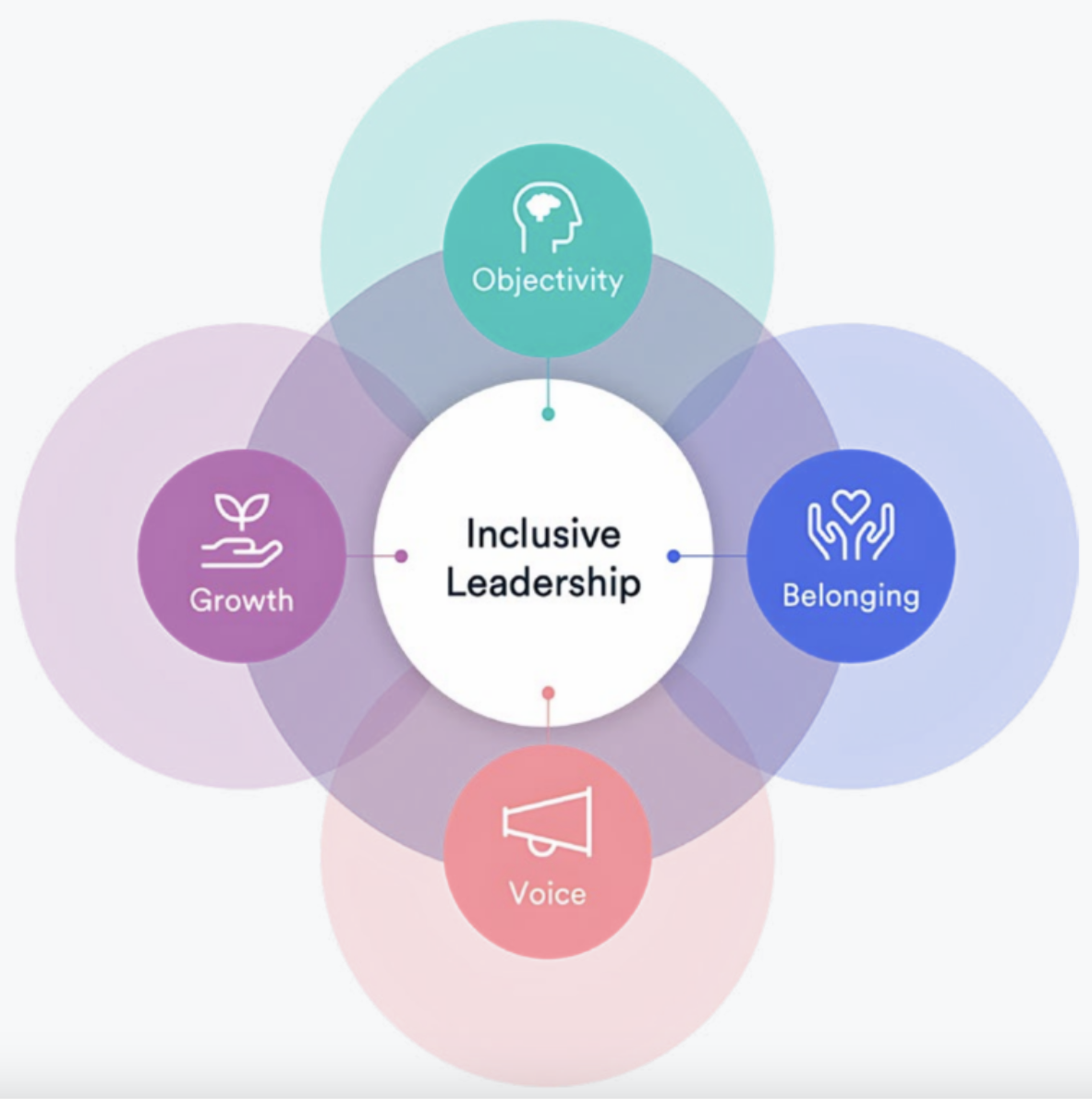
A clear framework helps you extract more value from employee engagement surveys. Paradigm’s four pillars of inclusive leadership can provide a lens to interpret survey findings holistically:
- Objectivity: Are promotions, performance reviews, and recognition fair? If surveys reveal concerns about objectivity, implement structured evaluation rubrics and bias awareness training.
- Belonging: Do employees feel valued and included across demographics? Belonging gaps signal a need to examine team norms and whether employees see people like themselves in leadership.
- Voice: Are ideas and feedback recognized and addressed? If employees don’t feel their voices are heard, evaluate meeting dynamics, idea-generation processes, and recognition systems.
- Growth: Are opportunities distributed equitably? Responses about limited growth require examining who gets stretch assignments and mentorship from senior leaders.
Engagement metrics only become meaningful when you tie them to specific actions and a system that aligns with inclusive leadership. Use these pillars to translate survey data into leadership behaviors and systemic change.
4 Best Practices for Measuring Impact and Sustaining Momentum
Impact is about people outcomes and business outcomes. These best practices for measuring survey results can help you drive meaningful improvements and maintain momentum.
1. Track Metrics Beyond Engagement Scores
Focusing solely on your organization’s overall level of engagement is misleading. You also need to consider belonging, fairness, psychological safety, employee retention, and internal mobility. Paradigm’s Benefits of Belonging report showed that: “When companies invest in programs and practices that improve the experience for employees who don’t feel like they belong, they see all employees’ benefit.”
For example, imagine overall engagement is 76%, but the belonging score for one demographic group is only 58%. Tracking sense of belonging alongside engagement helps you identify and close this equity gap, which improves outcomes for both the group and your organization as a whole.
Paradigm’s Culture for Everyone platform provides an integrated view of these metrics, helping unlock granular insights that guide the right actions for your people and your business.
2. Monitor Leading Indicators for Early Insights
Leading indicators predict future outcomes, such as how likely employees are to stay, allowing HR leaders to make proactive adjustments. Lagging indicators look backward, focusing on what’s already happened.
Examples of leading indicators include:
- Belonging and psychological safety scores
- Manager effectiveness ratings
- Perceptions of fairness in promotion processes
- Employee intention to stay
Examples of lagging indicators include:
- Turnover and attrition rates
- Time-to-fill for positions
- Promotion rates across demographics
- Performance ratings distribution
Tracking leading indicators helps you intervene before individual metrics turn into negative trends. Research from Visier shows that organizations monitoring leading indicators through predictive analytics can anticipate turnover and other workforce challenges, enabling proactive interventions.
3. Demonstrate ROI by Connecting Engagement to Business Outcomes
Improving engagement supports innovation and retention while reducing turnover costs. According to information published by Gallup, highly engaged teams are 23% more profitable. They also experience 78% lower absenteeism and 14% higher productivity.
Frame engagement survey results in business terms to demonstrate ROI. For example:
- “A 12% increase in belonging led to 18% higher retention, saving $2.4M in replacement costs.”
- “After implementing structured interview training, time-to-fill decreased by 3 weeks and candidate satisfaction increased 22%.”
Clearly communicating these outcomes to executives connects survey insights to financial impact, justifies engagement initiatives, and sets a baseline for future improvement.
4. Communicate Progress with Transparency and Storytelling
Communication is central to turning survey insights into action. Sharing what you’ve learned, the steps you’re taking, and the impact of those actions builds trust, accountability, and engagement.
Use storytelling techniques—pair survey data with employee experiences or team wins—to create a cohesive narrative that brings the employee journey to life. At the same time, maintain a centralized record of results and follow-up actions to ensure accountability and track progress over time.
Common Challenges and How To Solve Them
Even well-designed engagement surveys face predictable obstacles. Here’s how to anticipate and address the most common challenges.
Challenge 1: Low Response Rates Undermine Data Quality
When team members doubt anonymity or feel feedback won’t lead to action, they often don’t participate. Low response rates mean insights aren’t representative.
Build trust through transparency: clearly communicate confidentiality protections, explain why feedback is being collected, and share outcomes from previous surveys.
Paradigm’s Culture for Everyone framework provides guidance and trust-building practices that help leaders establish credibility. When employees see feedback consistently leading to action, response rates naturally improve.
Challenge 2: Survey Fatigue Reduces Engagement
Running too many surveys with too little follow-up can result in disengagement. Employees see surveys as performative exercises that waste time without producing meaningful change, and eventually, they stop participating.
Make every survey count by connecting it to visible follow-up and clear actions. Reduce survey frequency if you can’t demonstrate progress between surveys.
If you use pulse surveys, make them short and tied to specific initiatives. Paradigm Blueprint helps you link pulse survey insights directly to systemic interventions. You can track which actions were driven by which feedback, explicitly connecting employee input to organizational change.
Challenge 3: Lack of Leadership Buy-In Stalls Progress
Executives may see engagement surveys as HR-driven “check the box” exercises with little strategic value. Without leadership buy-in, insights gather dust, action plans go unfunded, and accountability mechanisms never materialize.
Frame survey data as business-critical culture intelligence, not HR sentiment tracking. Connect survey insights to outcomes executives care about: retention of top talent, innovation, productivity, and competitive advantage. Use concrete ROI examples, such as “Improving belonging scores by 20% is projected to reduce engineer turnover by 15%, saving $3.2M annually.”
Paradigm’s benchmarking studies, Inclusive Leadership framework, and analytics tools help connect survey results to leadership performance and demonstrate how culture investments drive business outcomes.
Challenge 4: Data Overload Creates Paralysis
HR leaders often receive pages of survey results—hundreds of data points, cross-tabs, and open-text responses—but no clear direction on where to start. That much information can lead to analysis paralysis, leaving nothing prioritized and nothing getting done.
Use a prioritization framework, such as an impact-versus-feasibility matrix, to focus on the key levers that will drive the most meaningful change. It’s better to do three things well and show measurable progress than to launch ten initiatives that all stall. Start with quick wins to build momentum, then tackle more complex systemic changes.
Paradigm acts as a strategic partner, filtering survey noise and helping you identify the most actionable insights. The platform makes it easy to see patterns across survey data, human resources metrics, and culture systems—and connect those insights to specific interventions.
Challenge 5: Privacy Concerns Limit Honest Feedback
Employees, especially those from underrepresented groups or in small departments, may fear retaliation or exposure when giving candid feedback. This feeling increases when survey categories make individuals easily identifiable (e.g., “female senior engineer in Platform Engineering” in a team of five). Without confidence in anonymity, feedback is more likely to be incomplete or inaccurate.
Prioritize robust anonymization practices. Set minimum thresholds for disaggregation (typically 5–10 respondents per category), and be transparent about how demographic data will be used and protected. Protecting anonymity isn’t just an ethical obligation—it’s a practical requirement for data quality.
Paradigm’s tools and frameworks prioritize secure, ethical data practices that balance anonymity with actionable insights. The platform helps organizations design survey structures and communication strategies that build trust while still enabling the disaggregation necessary to identify and address equity gaps.
What Success Looks Like
Theory and frameworks matter, but nothing beats seeing what’s possible when organizations put them into practice. Guild, a company focused on workforce education and career mobility, partnered with Paradigm to foster a culture of belonging for all employees.
Guild launched a blended learning journey using Paradigm Reach that combined online courses on microaggressions, bias, and allyship with peer-led discussions and practical tools.
The results:
- Understanding of how to use strategies to enhance inclusion jumped from 63% to 96%—a 33-point increase.
- Employees gained tangible tools for inclusive performance management and everyday interactions.
- Peer-led discussions helped build authentic engagement and connection across the organization.
Engagement Survey Tools and Trends
Platforms with AI-powered employee sentiment analysis, real-time dashboards, and continuous listening functionality are changing how companies collect and interpret feedback. Organizations are rapidly adopting these technologies alongside traditional survey approaches.
Tools like Paradigm can amplify your insights. AI can process thousands of open-text responses and identify themes at scale. Real-time dashboards help you monitor engagement trends as they emerge, not months later.
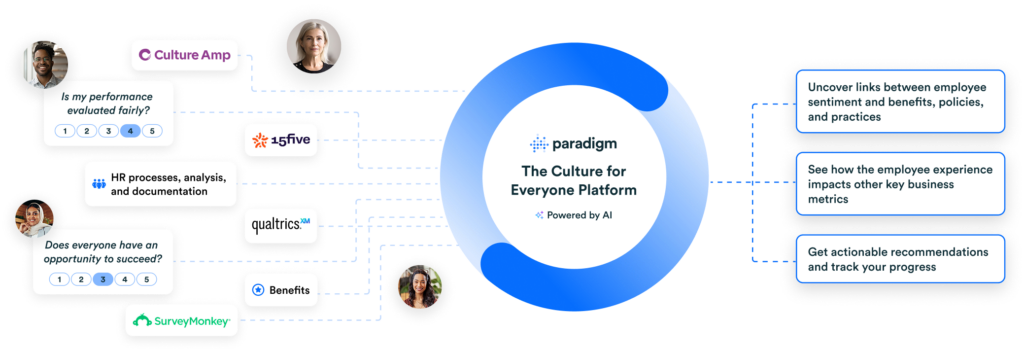
But a word of caution: Tools amplify insights, but they don’t create trust. Even the most advanced AI sentiment analysis tool won’t help if employees doubt confidentiality or the organization’s willingness to act on feedback.
Engagement survey success comes from leaders embedding objectivity, belonging, voice, and growth into operational systems—not from the sophistication of the survey platform.
Putting It All Together: Your Employee Engagement Survey Checklist
- Define your purpose. Before writing questions, clarify which outcomes you want the survey to inform—retention, promotion equity, manager effectiveness, or belonging.
- Design inclusively. Write bias-aware questions, ensure accessibility, protect anonymity, and build trust by explaining why the survey matters and how feedback will be used.
- Disaggregate data. Break results down by demographics, teams, departments, and levels to identify equity gaps that averages hide.
- Connect insights to systems. Link survey findings to turnover, promotions, employee performance ratings, and internal mobility to understand what’s driving outcomes.
- Create clear action plans. Assign accountable owners, measurable goals, and realistic timelines for the highest-impact priorities.
- Measure and communicate progress. Track belonging, fairness, and psychological safety alongside engagement, and close the loop by sharing results, actions, and progress with employees.
Turn Engagement Surveys Into Lasting Culture Change
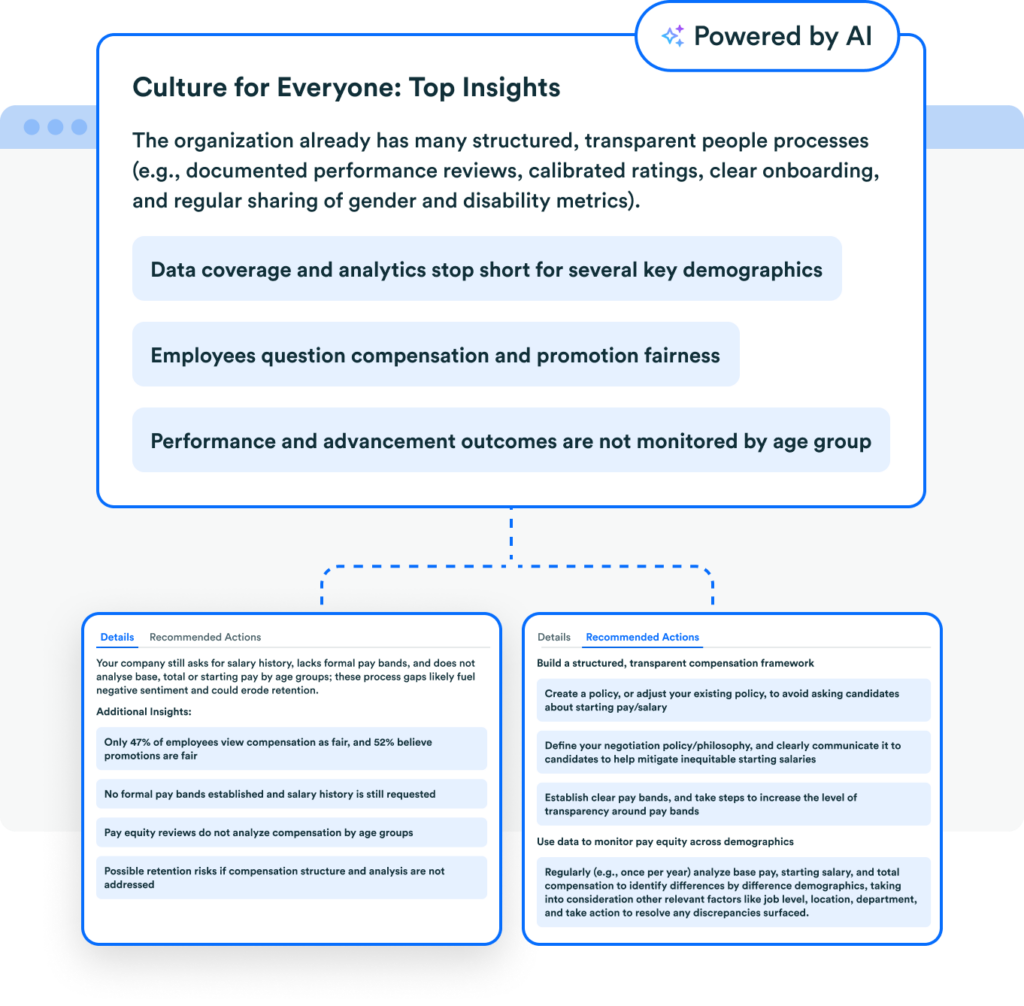
Employee engagement surveys aren’t endpoints—they’re catalysts. What matters is how well you connect data to systems, turn insights into action, hold leaders accountable, and show employees that their voices drive change.
Paradigm’s Inclusive Leadership pillars and Culture for Everyone framework help you view engagement as an outcome of how effectively your systems support objectivity, belonging, voice, and growth. Paradigm connects survey insights to leadership behaviors and organizational practices that drive measurable, sustainable improvements in performance, belonging, and retention.
Ready to transform how your organization uses engagement surveys? Learn more about Paradigm’s Culture for Everyone platform.
FAQs About Connecting Engagement Data to Action
What is an employee engagement survey?
An employee engagement survey is a tool for measuring how connected, motivated, and supported employees feel in their work and within the organization. It assesses employee satisfaction, belonging, manager effectiveness, growth opportunities, psychological safety, and alignment with organizational values. Well-designed surveys go beyond merely collecting such sentiments by connecting insights to systems and guiding actions that improve employee experience and business outcomes.
What are good employee engagement survey questions?
Good questions are actionable, specific, and tied to decisions. Examples include: “I have equal access to growth opportunities regardless of background,” “My manager recognizes contributions fairly,” “I feel comfortable sharing ideas that challenge the status quo,” and “Our performance review process evaluates people equitably.” It’s essential to use a mix of rating-scale questions for trends and open-text questions to capture context and nuance.
How often should you run an engagement survey?
Most organizations benefit from a comprehensive annual survey supplemented by quarterly pulse surveys on targeted topics. Annual surveys provide benchmarks, while pulse surveys track progress and help assess the impact of ongoing initiatives. Ultimately, frequency matters less than consistency and follow-through—never run a survey unless you’re committed to acting on results.
What should you do after an employee engagement survey?
Disaggregate results to identify disparities, connect findings to business and HR metrics, and prioritize using an impact–feasibility framework. Create clear action plans with owners and timelines, embed accountability in leadership goals, and communicate results and actions transparently. Use pulse surveys to track progress and close the loop by showing employees how their feedback informed real change.