
Carissa Romero, PhD
As one of Paradigm’s Co-Founders, Carissa helped develop Paradigm’s philosophy around evidence-based talent and culture work.
Organizations today are navigating an unprecedented convergence of change. Artificial intelligence is rapidly reshaping how work gets done. Economic uncertainty continues to stretch teams and resources. And workforces are evolving — generationally, technologically, and culturally — faster than many organizations were designed to accommodate.
In moments like this, it’s easy for leaders and teams to feel stretched thin. But periods of disruption also create an opportunity to rethink how work happens, how talent is developed, and what kind of culture will enable organizations not just to adapt, but also to thrive.
One of the most powerful levers leaders have in times of sustained change is often overlooked: cultivating a culture of growth mindset.
Growth Mindset: A Foundation for Navigating Change
At its core, a growth mindset is the belief that people can develop their skills, intelligence, and capabilities over time. This stands in contrast to a fixed mindset, which is the belief that talent and ability are largely static traits.
Decades of research, beginning with Stanford psychologist Carol Dweck, show that when people approach work with a growth mindset, they perform better. They are more likely to prioritize learning over proving themselves, to persist through setbacks, and to see effort and struggle as part of the path to improvement rather than as signals of inadequacy.
In stable environments, a growth mindset may feel like a “nice to have.” But in periods of rapid change, it becomes essential. AI, automation, and evolving business models demand continuous learning. Roles are shifting faster than job descriptions can keep up. Success increasingly depends not on what people already know, but on how quickly they can learn, adapt, and collaborate in new ways.
It’s no surprise, then, that interest in fostering a growth mindset has surged in recent years. Leaders across industries are recognizing that thriving through change requires a workforce that doesn’t just tolerate uncertainty, but actively engages with it as a source of opportunity.
From Individual Mindsets to Organizational Culture
Early research on growth mindset focused primarily on individuals: how a person’s beliefs shape their motivation and performance. More recent research has revealed something even more consequential for leaders: culture determines which mindset shows up at work.
In cultures that emphasize learning, development, and experimentation, most people — regardless of their default mindset — are more likely to behave in growth-oriented ways. They try new approaches, seek feedback, and adapt in the face of challenges.
By contrast, in “cultures of genius,” where only a small group of perceived stars are valued and people feel pressure to constantly prove their competence, even individuals with a strong growth mindset begin to act defensively. They avoid experimentation, resist change, and shy away from situations where they might fail.
This insight is empowering. It means leaders don’t need to diagnose or fix individual mindsets. Instead, their role is to shape the environment—the systems, norms, and signals—that determine which mindset shows up at work.
When organizations consistently reward learning, experimentation, and improvement, they create an organizational growth mindset—one that enables people to take risks, seek feedback, collaborate, and adapt, regardless of where they start individually. In this way, culture doesn’t replace individual mindset; it activates the behaviors that growth mindset makes possible.
What Growth Mindset Looks Like in Practice
Organizations that invest in cultures of growth tend to cultivate qualities that are especially critical in times of transformation: resilience, collaboration, and agility.
A well-known example is Microsoft’s cultural shift under CEO Satya Nadella. Recognizing that a new business strategy would require a parallel cultural evolution, Nadella framed the transformation as a move from a “know-it-all” culture to a “learn-it-all” culture. That framing operationalized growth mindset at scale. Leadership behaviors shifted toward curiosity and humility, and systems were redesigned to emphasize coaching and continuous improvement.
The result was not just cultural change, but renewed innovation and performance. The lesson is clear: when learning, rather than proving competence, becomes the goal, organizations unlock the ability to adapt faster and more effectively.
Three Leadership Practices That Enable Growth Through Change
So how can leaders intentionally build cultures that don’t just survive disruption, but use it as fuel for innovation? Research and practice point to three critical leadership behaviors.
1. Model Humility
The most important place to start is leadership behavior. People will not take risks, admit mistakes, or try new approaches unless they see those behaviors modeled from the top.
Modeling humility means openly acknowledging what you don’t know, sharing your own learning process, and talking candidly about mistakes and what you’ve learned from them. When leaders do this consistently, they send a powerful signal: growth is valued more than perfection.
This is especially important when organizations are experimenting with new technologies like AI. Early attempts won’t always work. Leaders who share their own experimentation, and their missteps, create psychological safety for others to do the same. That openness accelerates learning and reduces the fear that often slows adoption of new tools.
2. Reward Learning, Not Just Outcomes
What leaders praise and recognize shapes culture every day. Too often, recognition focuses on innate brilliance or flawless execution. In growth-oriented cultures, recognition shifts toward how results are achieved.
That might mean praising someone for seeking out diverse perspectives, iterating after early failure, or investing time upfront to learn a new system that pays off later. Some organizations go even further, explicitly celebrating lessons learned from failed experiments to normalize risk-taking and learning.
This matters because innovation almost always involves upfront effort and uncertainty. Without reinforcement, people default to familiar ways of working even when better approaches are available. Rewarding learning helps teams push through the discomfort that comes with change.
3. Pair Rigor With Support
High-performance cultures require high standards, but standards alone are not enough. Growth thrives when rigor is paired with support.
Research on effective mentorship shows that people are most motivated when they believe two things: that high standards matter, and that their leaders believe they can meet those standards with support. Feedback, when framed as an investment in someone’s growth rather than a judgment of their ability, becomes a catalyst for improvement rather than a threat.
In periods of rapid change, this balance is especially important. People may feel stretched, uncertain, or worried about getting things wrong. Leaders who combine clear expectations with tangible support — prioritization, coaching, and access to resources — help teams see new challenges not as risks to avoid, but as opportunities to grow.
Thriving, Not Just Adapting
Change is no longer episodic. It is constant. The organizations that will succeed in the age of AI are not those that try to minimize disruption, but those that build cultures capable of learning through it.
A growth mindset culture reframes change as the place where growth happens. It empowers people to experiment, learn, and improve continuously. And it gives leaders a practical framework for guiding teams through uncertainty with confidence and purpose.
When leaders model humility, reward learning, and pair rigor with partnership, they do more than help their teams cope with change. They create the conditions for innovation, resilience, and sustained performance — no matter how fast the world evolves.
From Individual Mindsets to a System That Learns
For many leaders, the instinctive response to rapid change is to look for more training. Another course. Another workshop. Another playbook. But thriving through disruption requires more than skill-building in isolation. It requires a system-level shift: from cultures organized around proving expertise to cultures designed for continuous learning.
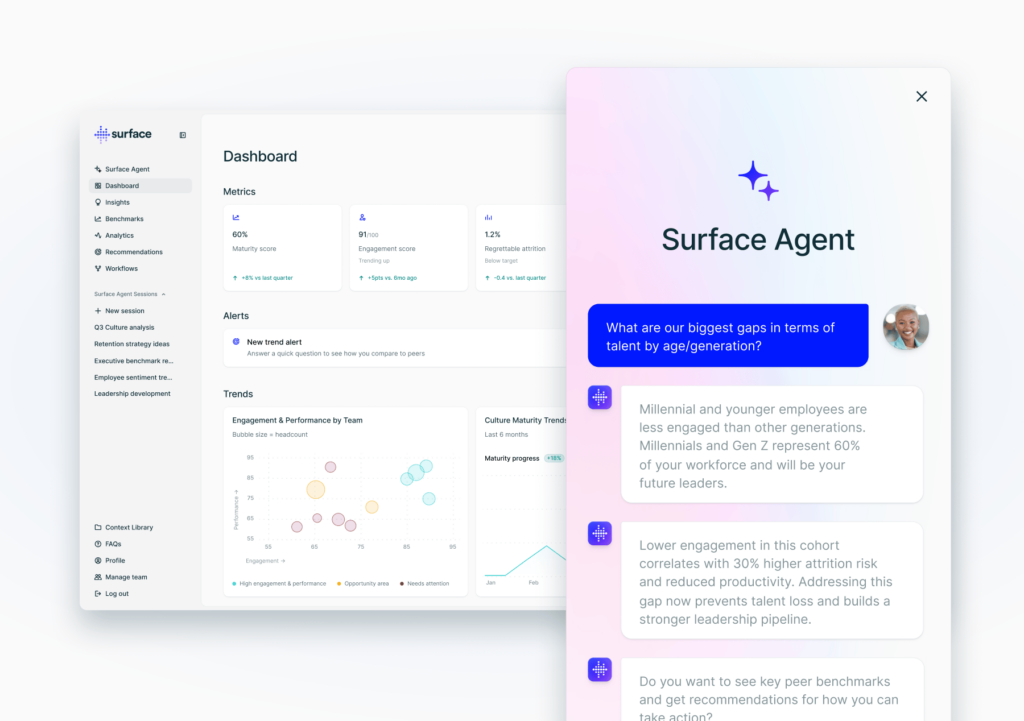
That shift doesn’t happen through mindset training alone. It happens when organizations pair growth-oriented leadership behaviors with the right infrastructure: tools that surface where learning is happening (and where it isn’t), data that reveals gaps between intent and experience, and shared insight into how peers are navigating similar challenges. In other words, a growth mindset becomes most powerful when it is embedded into how organizations learn from data, experimentation, and change itself.
This is where AI fundamentally changes what’s possible. When used thoughtfully, AI doesn’t just automate existing workflows — it enables organizations to see patterns they couldn’t see before, to learn faster from employee experience, and to move from reactive adjustments to proactive cultural evolution. In that environment, learning is no longer episodic or dependent on individual heroics. It becomes part of the operating system.
At Paradigm, we believe this is the next frontier of high-performance culture: not just helping people adapt to change, but building organizations that are designed to learn through it. The companies that will lead in the age of AI won’t be the ones with the most talent on paper. They’ll be the ones that create cultures where curiosity is rewarded, experimentation is safe, and insight compounds over time.
Change is already here. The question leaders face is not whether their organizations will adapt, but whether they will build the systems, mindsets, and cultures that allow their people to truly thrive.